
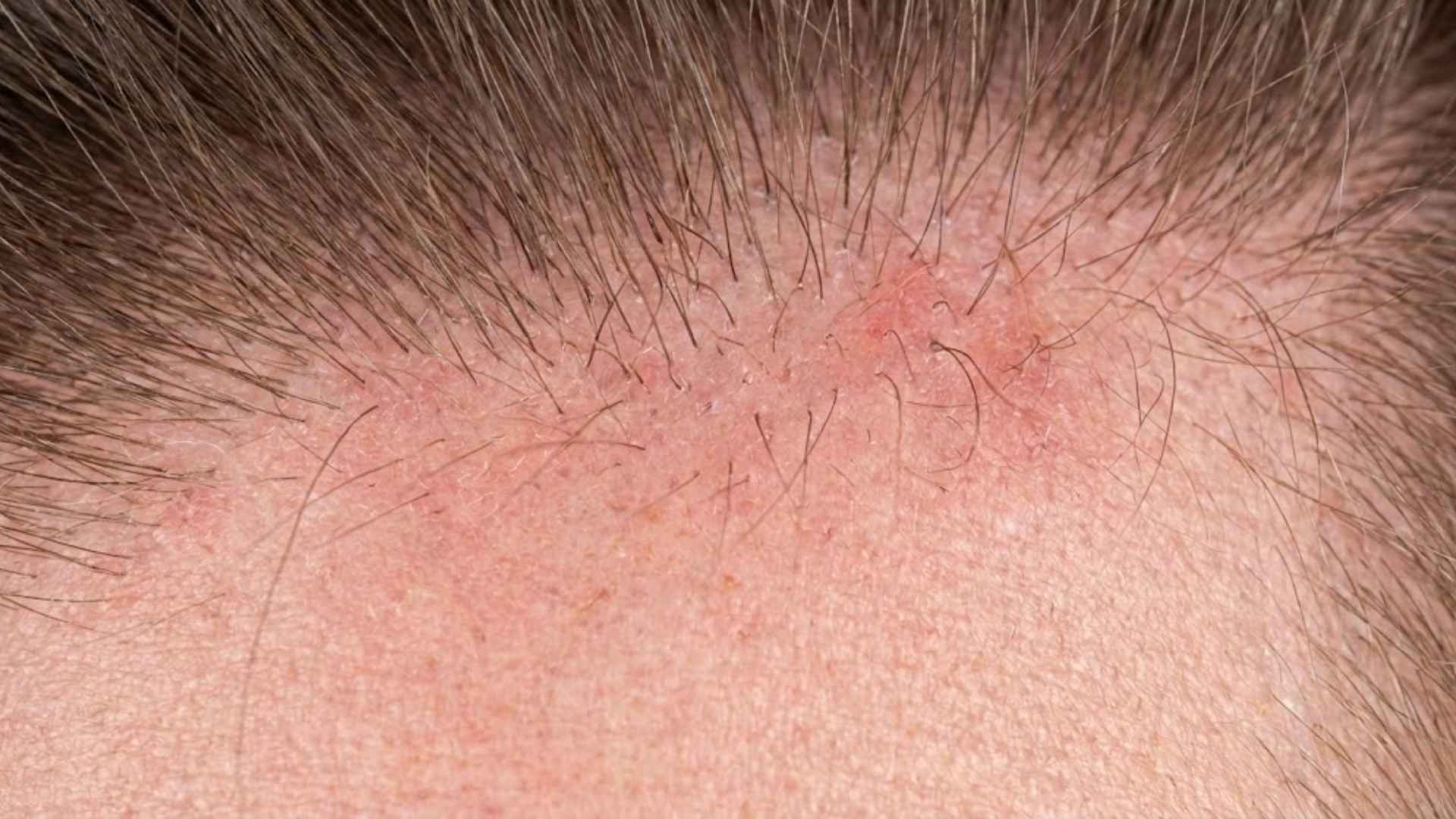
You wash your hair daily, use clarifying shampoos, and see zero flakes on your shoulders. Yet, Scalp Itches But No Dandruff Flakes. When you scratch your scalp, your fingernails come away coated in a thick, waxy, white paste. Here is how you can soothe a Itchy Scalp with with a 5-step approach.
Generic advice like “reduce stress” or “eat greens” is useless. It does not address the real cause. If you feel intense itching without visible “snowfall,” something deeper is happening. You may be trapped in a damaging scalp cycle. This cycle includes mineral buildup. It also includes fungal overgrowth.
Compensatory oil production makes the problem worse. This is a Protocol Failure, not a hygiene one.
THE HIDDEN TRIGGERS
If you have tried everything and still have an itchy scalp. It is because you are fighting the wrong battle. Here are the hidden variables that generic guides miss, uncovered by clinical research and the experiences of those who finally found relief:
The Hard Water Trap:
- Dissolved minerals in tap water bond with sebum.
- This creates “soap scum,” also known as calcium sebate.
- The result is a waxy, clay-like residue.
- Standard shampoos cannot dissolve this buildup.
Malassezia’s “Silent” Stage:
- This yeast lives on everyone’s scalp.
- Overgrowth causes inflammation and itching.
- However, it can take three weeks for visible flakes to appear.
- The itching starts long before the flakes do.
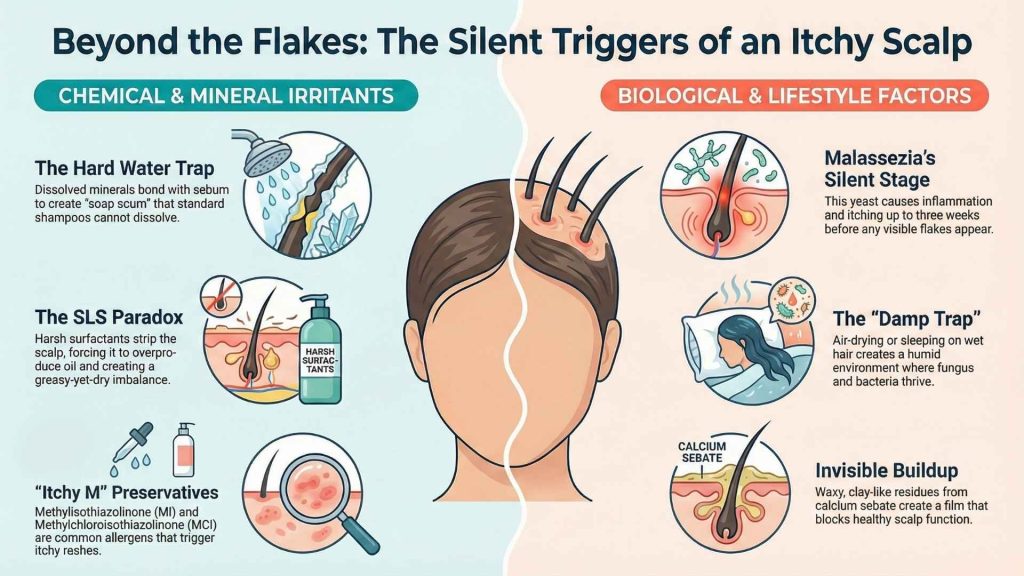
The SLS Paradox:
- Harsh surfactants like Sodium Lauryl Sulfate (SLS) strip the scalp aggressively.
- This forces the skin to overproduce oil to compensate.
- The result is a “greasy but dry” imbalance.
The “Damp Trap”:
- Air-drying or sleeping on wet hair creates a humid environment.
- This humidity allows fungus and bacteria to thrive.
- It leads to faster buildup on the scalp.
The “Itchy M” Preservatives:
- Methylisothiazolinone (MI) and Methylchloroisothiazolinone (MCI) are common allergens.
- They are found in many shampoos.
- They can cause an itchy rash.
- This can happen even if you have no dandruff.
THE PROTOCOL (STEP-BY-STEP)
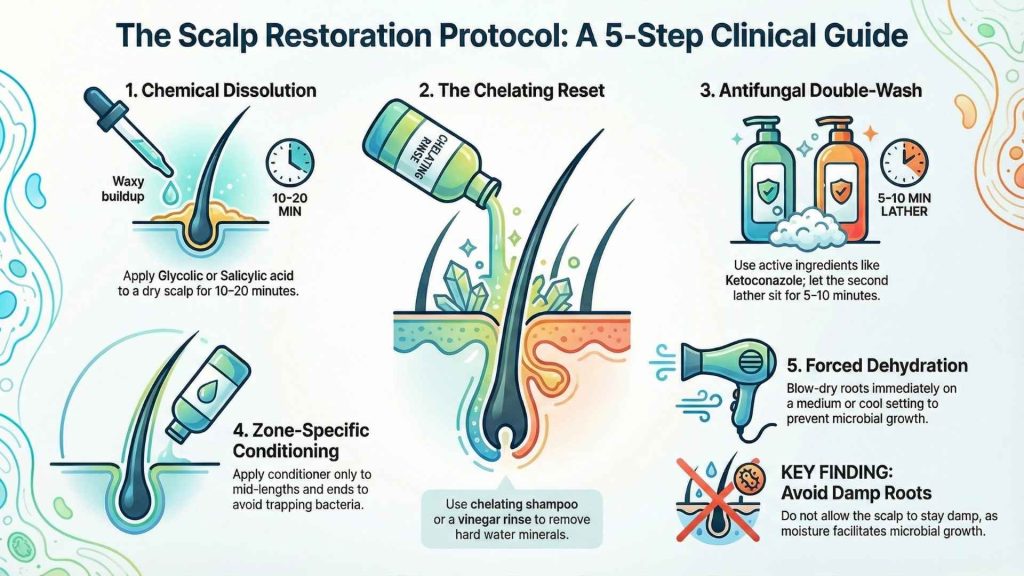
Follow these rigid instructions to eliminate the waxy buildup and restore scalp health.
- Step 1: Chemical Dissolution. Apply a chemical exfoliant like Glycolic Acid (7%) or Salicylic Acid directly to a dry scalp. Leave for 10–20 minutes to break the “cement” bonds of dead skin and sebum.
- Step 2: The Chelating Reset. Wash with a Chelating Shampoo to remove mineral buildup from hard water. Alternatively, use an acidic rinse consisting of 2 tablespoons of vinegar in 1 liter of water.
- Step 3: The Antifungal Double-Wash. Use a shampoo containing Ketoconazole (Nizoral), Selenium Sulfide (Selsun Blue), or Piroctone Olamine181818181818. Massaging is key to reaching the hair follicles. Let the second lather sit for 5–10 minutes before rinsing to ensure the active ingredients can work.
- Step 4: Zone-Specific Conditioning. Apply conditioner only to the mid-lengths and ends. Never apply it to the scalp, as surfactants in conditioners can be more irritating than those in shampoo and can trap bacteria.
- Step 5: Forced Dehydration. Blow-dry your roots immediately on a medium or cool setting. Avoid high heat to protect the scalp barrier, but do not allow the scalp to stay damp, as moisture facilitates microbial growth.
The “Tool Trap” (Scalp Health & Hygiene)
Many people use scalp massagers, brushes, or even just their fingernails aggressively to relieve the itch or “scrub out” the waxy paste. While the intention is to exfoliate, this often backfires.
- The Issue: Using fingernails or stiff brushes on an already inflamed scalp causes micro-abrasions. These tiny cuts allow bacteria and yeast (like Malassezia) to penetrate deeper into the skin, worsening the inflammation and itching. Furthermore, if these tools aren’t cleaned regularly, they harbor dead skin cells, oil, and product residue, effectively re-introducing the “gunk” you just washed away back onto your clean scalp.
- Where to Insert: This could be added as a “Hidden Trigger” or a “Critical Mistake” section before the protocol, or integrated into Step 3 (The Antifungal Double-Wash) , emphasizing that massage should be done with soft fingertips, not nails, to avoid creating micro-trauma.
The “Post-Wash Fabric Contact” (Pillowcase & Towel Hygiene)
The protocol focuses heavily on what you put on your scalp, but it doesn’t address what your scalp touches for 8 hours a day.
- The Issue: Even after a successful “Chelating Reset” and “Antifungal Double-Wash,” sleeping on a dirty pillowcase can immediately undo the work. Pillowcases absorb sweat, sebum, dead skin cells, and leftover product. They also accumulate laundry detergent residue and fabric softener, which contain fragrances and oils that can further irritate a sensitive scalp. This creates a breeding ground for microbes and reintroduces the “soap scum” minerals onto the skin overnight.
- Where to Insert: This could be added as a “Maintenance” note after the protocol, or as a sixth step titled “Environmental Hygiene.” The advice would be to use clean, 100% cotton pillowcases (which are more breathable than satin or synthetic blends) and wash them weekly in hot water with a hypoallergenic, fragrance-free detergent.
THE REALITY CHECK
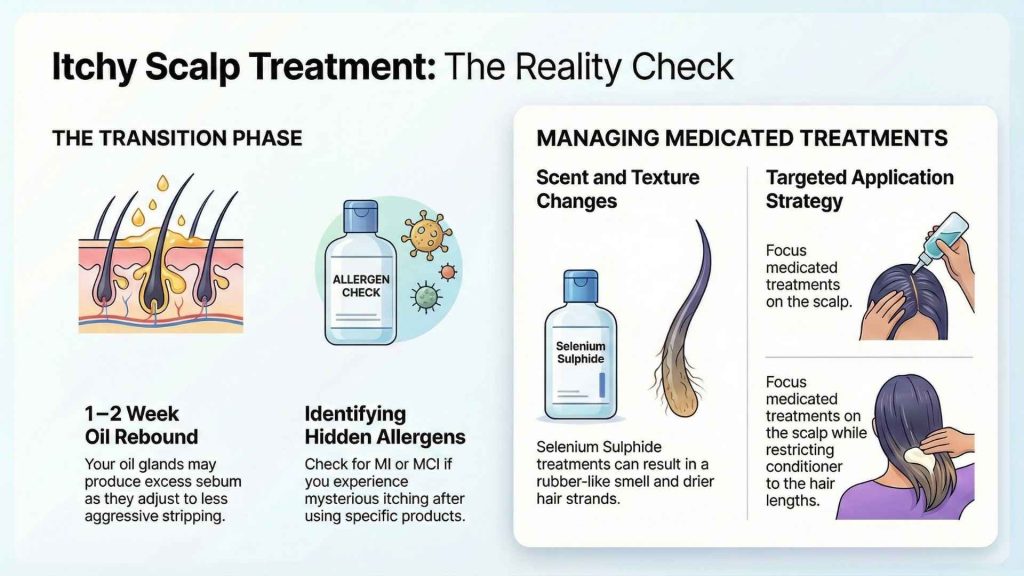
- The Rebound Oil: Your scalp may feel oily for 1–2 weeks as your oil glands adjust to less aggressive stripping.
- Allergy Alerts: If you aren’t allergic to an ingredient, you don’t need to avoid it, but mysterious itching after a specific product is a sign to check for allergens like MI or MCI.
- Texture Changes: Medicated shampoos like Selenium Sulfide can smell like sulfur or rubber and may dry out your hair. Focus the treatment on the scalp and keep conditioning restricted to the hair lengths.
FREQUENTLY ASKED QUESTIONS
Yes. Minerals like calcium in hard water bond with your natural scalp oils and shampoo to create an insoluble “soap scum”. This results in a thick, doughy residue that gets stuck under your nails.
This is often caused by using harsh sulfates (SLS) that strip your scalp’s moisture, triggering “compensatory oiliness” where your skin overproduces sebum to protect itself. Additionally, product residue or hard water mineral buildup can leave a waxy film that feels unclean even after a shower.
Absolutely. Itching and inflammation caused by the Malassezia fungus often precede visible flaking by up to three weeks. You may feel the irritation and see waxy buildup under your nails before any “snowfall” occurs on your clothing.
Yes. Leaving the scalp damp—especially if you have thick hair or sleep on it wet—creates a humid environment that promotes fungal and bacterial growth. Thoroughly drying your roots with a hairdryer is a critical preventative step.
Conclusion
An itchy scalp accompanied by a waxy, paste-like residue is rarely a sign of poor hygiene, but rather a sign of a complex interaction between your water, your microbiome, and your products. By understanding the difference between visible dandruff and this “silent” buildup, you can move beyond generic advice. This 5-step protocol is designed to interrupt that destructive cycle. It focuses on chemical dissolution, mineral chelation, and targeted antifungals. Strategic conditioning and forced dehydration are also key components. Restoring the scalp’s natural barrier requires this level of precision. By following these rigid steps, you move beyond managing symptoms. You achieve a clinically clean, healthy, and itch-free foundation for hair growth.
Disclaimer: The information provided in this article is for educational and informational purposes only and is not intended as medical advice.