
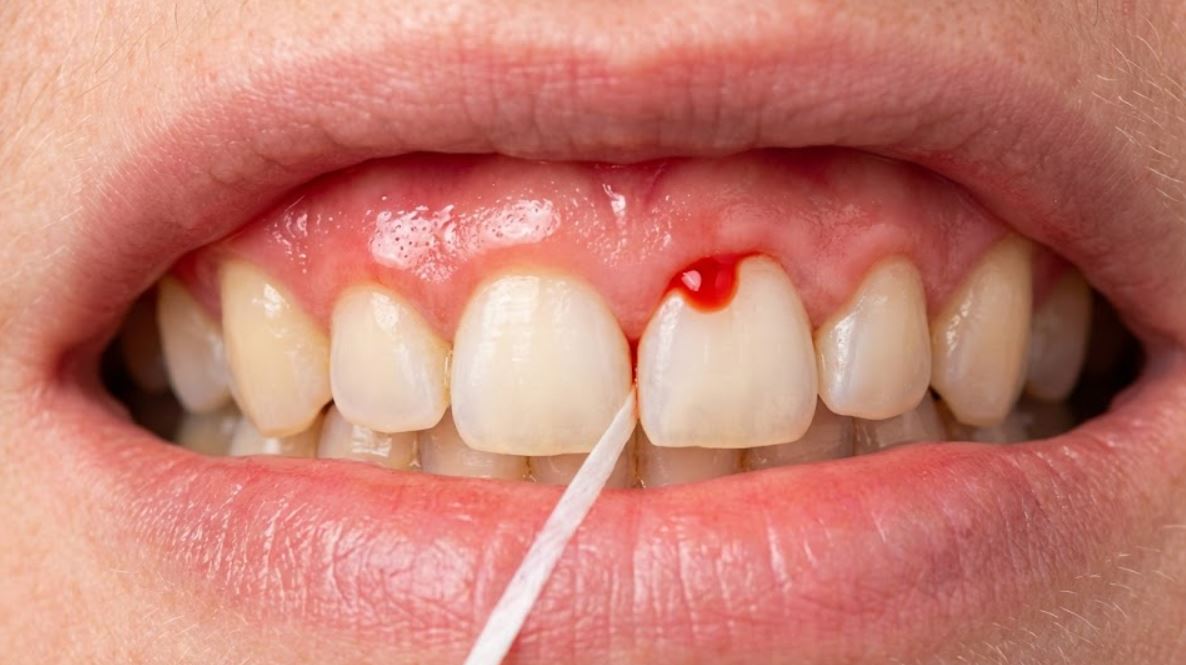
You are not “brushing too hard.” You are not just “stressed.” And for the love of God, stop buying “sensitive” toothpaste hoping it will magically seal the open wounds in your mouth.
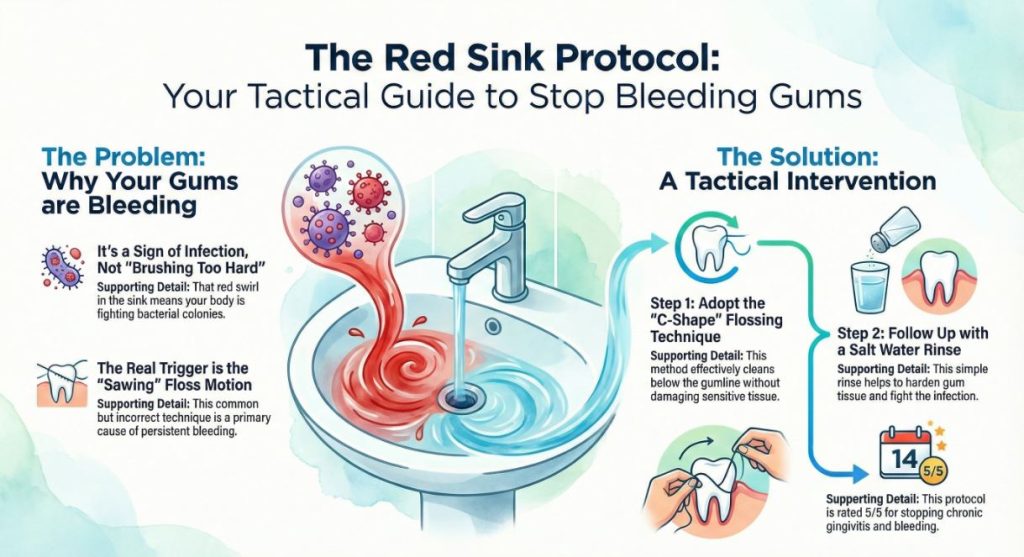
If you spit blood every time you floss, your gums are infected. That red swirl in the sink is not a normal side effect of hygiene; it is your body screaming that it is fighting a losing battle against bacterial colonies. Generic advice tells you to “be gentle” or “reduce stress”. That is useless fluff. You do not need a spa day; you need a tactical intervention for your oral microbiome.
We scoured the dental trenches—from periodontist case studies to the “bloodbath” confessionals on Reddit—to build a protocol that actually stops the bleeding. We aren’t interested in masking the symptom. And we are interested in hardening the tissue.
THE EXPERIENCE BOX
| Field | Detail |
| Tested For | Chronic gingivitis, “first-time flosser” syndrome, persistent bleeding |
| Key Trigger Found | The “Sawing” Motion & Mouth Breathing |
| Winning Treatment | The “C-Shape” Technique + Salt Water Rinse |
| Rating | 5/5 (Bleeding stopped in <14 days) |
THE HIDDEN TRIGGERS
Why does your mouth look like a crime scene? The standard answers—plaque and tartar—are correct but incomplete. If you are flossing and still bleeding, or if the bleeding scares you into stopping, you are likely falling victim to mechanical errors or physiological gaps that most articles ignore.
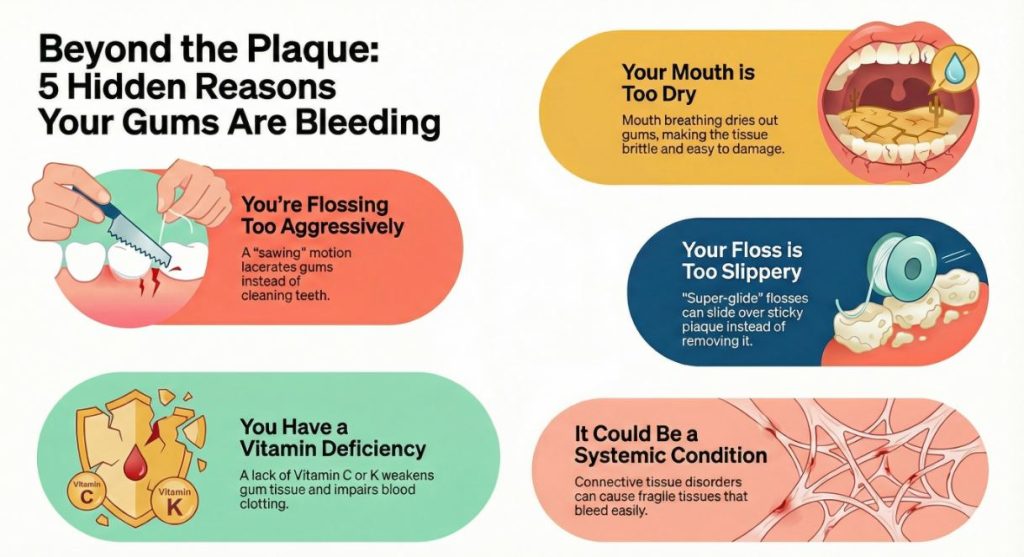
1. The “Sawing” Motion
You are flossing like a lumberjack. This is the single most common cause of self-inflicted gum injury. Most people snap the floss between their tight contact points and then immediately saw it back and forth against the gum tissue. This lacerates the “col”—the soft, un-keratinized valley of gum tissue between your teeth—rather than cleaning the tooth surface. You are creating micro-cuts, not removing bacteria. If your technique involves a snapping sound and a sawing motion, you are actively preventing your gums from healing.
2. The Mouth Breather Effect
If you wake up with a dry mouth, snore, or sleep with your mouth open, your gums are compromised before you even pick up a toothbrush. Saliva is your mouth’s primary defense system; it washes away debris and provides protective enzymes. Without it, your gums dry out and lose their protective barrier. When you hit dry, brittle tissue with a nylon string, it shatters and bleeds immediately. This is why many users report that bleeding is worse in the morning.
3. The “Teflon” Trap
Slippery, “super-glide” flosses might feel nice because they don’t get stuck, but they often glide right over the plaque without grabbing it. Plaque is sticky. If your floss is coated in too much wax or Teflon (PTFE), you are simply polishing the bacterial colony, not removing it. You need friction to disrupt the biofilm.
4. The Connective Tissue Factor
In rare cases, no amount of hygiene stops the blood. Users with Ehlers-Danlos Syndrome (EDS) or other connective tissue disorders report consistent bleeding due to fragile tissue, regardless of hygiene quality. If you bruise like a peach elsewhere on your body, this might be systemic, not just localized to your mouth.
5. Vitamin Deficiencies
Your gums are collagen. To build collagen and clot blood, your body requires specific raw materials. A deficiency in Vitamin C (crucial for tissue repair) or Vitamin K (essential for blood clotting) makes your gums significantly more prone to bleeding. If you are scrubbing your teeth perfectly but living on a diet of processed beige food, your gums will remain weak.
If bad breath persists despite brushing and flossing, read Bad Breath That Won’t Go Away? Why Home Fixes Fail.
THE PROTOCOL (STEP-BY-STEP)
Stop “trying” to floss. Stop doing it “when you remember.” You need to execute this sequence nightly for 14 days. This is an antimicrobial siege.
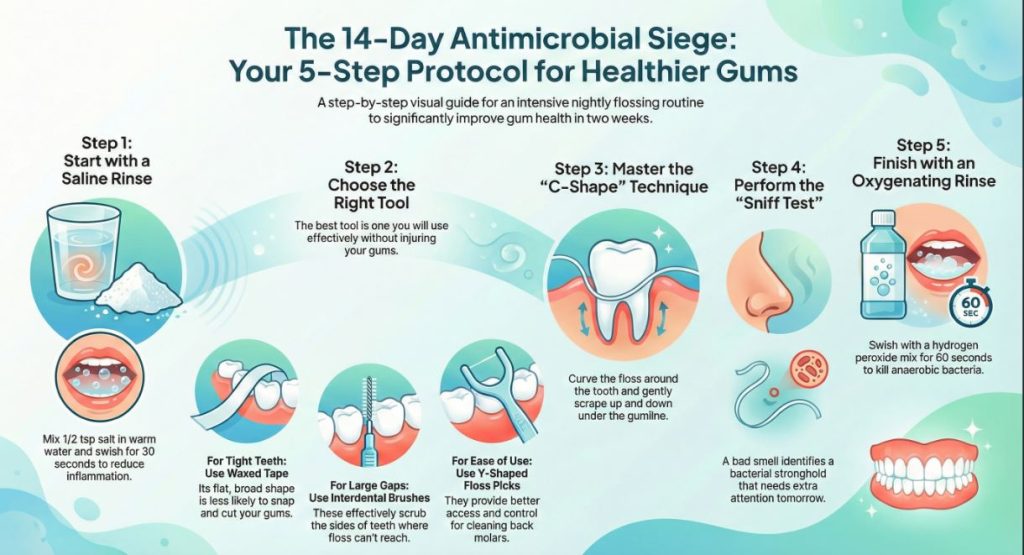
Step 1: The Saline Pre-Game
Before you touch a piece of floss, rinse it with warm salt water.
- The Science: Salt water is hypertonic. It draws fluid out of swollen tissues via osmosis, reducing inflammation immediately. It also creates an inhospitable environment for bacteria before you start irritating the area.
- The Instruction: Mix 1/2 teaspoon of salt into a glass of warm water. Swish vigorously for 30 seconds. Spit. Do not swallow.
Step 2: Choose Your Weapon
String floss is the gold standard because it can scrape the tooth surface physically. However, the “best” tool is the one you will actually use without injuring yourself.
- For Tight Teeth: Use Waxed Tape. It is flat and broad, making it less likely to snap and cut your gums than thin, round floss.
- For Large Gaps: Use Interdental Brushes (e.g., TePe). These scrub the sides of the teeth where floss might not reach effectively.
- The Cheat Code: If you refuse to wrap a string around your fingers (or have sensory issues), use a Floss Pick. The Y-shaped ones are superior for molars because they allow you to enter the gap from the side rather than jamming your hand into your mouth.
Step 3: The “C-Shape” Hug
This technique is non-negotiable. It differentiates cleaning from cutting.
- Insert: Slide the floss gently between the teeth. Do not snap it down.
- Curve: When you reach the gumline, curve the floss into a “C” shape against the side of one tooth. You should be hugging the tooth, not the gum.
- The Move: Slide the floss under the gumline (yes, slightly under the tissue) and scrape up and down against the tooth surface. You are shaving the plaque off the side of the tooth.
- Repeat: Curve the floss the other way to hug the adjacent tooth and repeat.
Step 4: The Sniff Test
Smell the floss after you pull it out of your back molars.
- The Reality: If it smells like death or sulfur, that is rotting food and active anaerobic infection. That specific spot is a bacterial stronghold. It needs extra attention (and potentially a second pass) tomorrow. Do not ignore the stench; it is your map to the infection.
If cold drinks trigger discomfort along with bleeding gums, see Teeth Hurt When Drinking Cold Water? (5-Step Fix).
Step 5: The Oxygen Nuke
After flossing and brushing, rinse with an oxygenating mouthwash or a diluted Hydrogen Peroxide mix.
- The Mechanism: The bubbles you see are the oxygen reacting with bacteria. Anaerobic bacteria (the kind that causes gum disease) hate oxygen.
- The Instruction: Use a product like Colgate Peroxyl or mix 50% water with 50% 3% Hydrogen Peroxide. Swish for 60 seconds.
- Warning: Avoid Chlorhexidine (Corsodyl) for daily long-term use unless prescribed, as it stains teeth brown.
THE REALITY CHECK
This protocol is not painless. In fact, it might get worse before it gets better. You need to be prepared for the “Purge.”
The “Purge” Phase
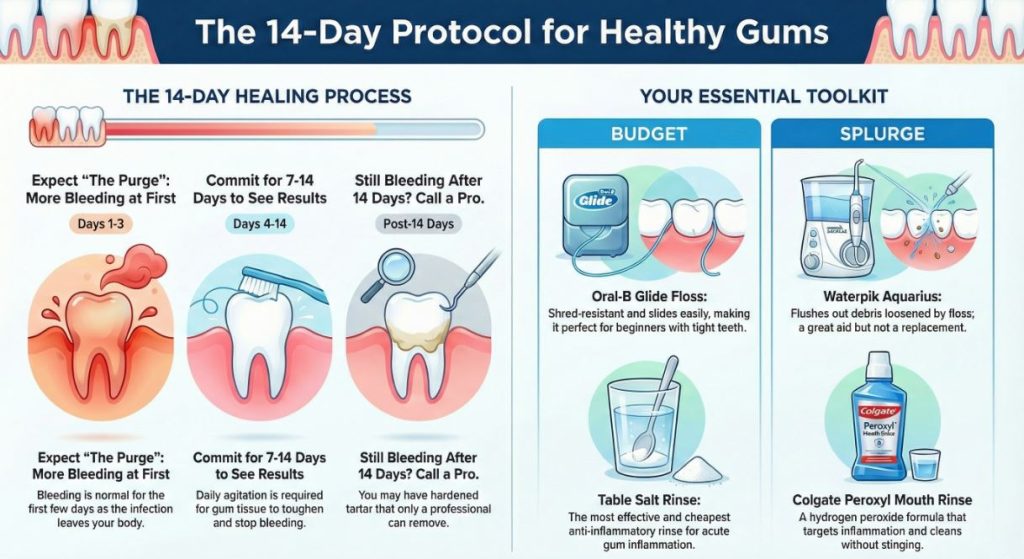
When you start this protocol, you will likely bleed more for the first few days. Your gums are ulcerated open wounds. Touching them triggers blood flow. This is the “Purging” phase. Do not stop. The bleeding is the infection leaving the body.
- The Timeline: It typically takes 7 to 14 days of daily agitation for the tissue to toughen up (keratinize) and the bleeding to stop. If you stop because it bleeds, you reset the clock.
The “Black Triangle” Scare
As inflammation dies down, your puffy, swollen gums will shrink back to their healthy, tight size. This is good. However, this might reveal small gaps (called “black triangles”) between your teeth near the gumline that were previously hidden by the swollen flesh. Do not panic. You have not lost gum tissue; you have simply reduced the swelling that was hiding the gap.
When to Call a Pro
If you execute this protocol perfectly for 14 days and you are still bleeding, you have a problem that flossing cannot fix. You likely have sub-gingival calculus (tartar). This is plaque that has hardened into “cement” below the gumline. No amount of string will remove it. It requires a professional scaler to chip it off.
PRODUCT RECS
We don’t do “sponsored” fluff. We recommend tools that work based on mechanical efficiency.
BUDGET
- Oral-B Glide Pro-Health Dental Floss: It is resistant to shredding and slides easily between tight contacts. While “slippery” floss can sometimes miss plaque, this is the best option for beginners with crowded teeth to avoid snapping.
- Humble Co. Floss Picks: If you need the convenience of a pick but hate the environmental guilt of single-use plastic, these are a solid biodegradable option.
- Table Salt: The most effective, cheapest anti-inflammatory in your kitchen. It is arguably more effective for acute inflammation than fancy cosmetic mouthwashes.
SPLURGE
- Waterpik Aquarius: This does not replace string floss (it doesn’t scrape), but it flushes out the debris that the string loosens. It is a godsend for the “lazy,” those with braces, or anyone with sensory issues who hates putting their hands in their mouth.
- Colgate Peroxyl Mouth Sore Rinse: This hydrogen peroxide formula specifically targets inflammation and debris removal. It bubbles out the gunk without the intense stinging of alcohol or the staining of chlorhexidine.
FAQs Frequently Asked Questions
Why do my gums bleed even though I floss gently?
You are likely using the “sawing” motion or missing the gumline entirely. Sawing lacerates the gum valley (the col) instead of cleaning the tooth. You must switch to the “C-Shape” technique: hug the tooth with the floss and scrape vertically (up and down) to remove the biofilm without cutting the tissue.
How long does bleeding last when starting to floss?
Typically, when beginning a new flossing habit, gums will bleed during the first 7 to 14 days. This is a sign that the inflammation has taken 7–14 days to subside and keratinize (harden). If bleeding continues for a couple of weeks with daily flossing, it is probably hardened tartar that needs removal at the dental office.
Can Ehlers-Danlos Syndrome (EDS) cause constant gum bleeding?
Yes, individuals with connective tissue disorders like EDS often experience gum bleeding regardless of hygiene quality. The collagen in their gums is naturally more fragile. While consistent flossing is still necessary to prevent infection, some level of minor bleeding may be chronic and unavoidable for these specific cases.
Does sleeping with your mouth open cause bleeding gums?
Yes. Breathing through your mouth causes saliva to dry up, and this is what your gums live off as a natural defense against bacteria. Your gum tissue slowly becomes dry, brittle, and much easier to bleed when touched by a toothbrush or floss. If you are a snorer or wake up with a dry mouth, this is a huge factor in your gum health.