
You sip an ice water, and it strikes you—painful, electric shock travelling through your jaw, dropping you to your knees. And you wait, rub your cheek; does your tooth have a pulse? You search for answers, and the internet offers the same tired, generic advice: “Brush gently” or “Avoid ice cream.”
This advice is useless. If simply “brushing softer” were the cure, you wouldn’t be here reading this.
The standard advice fails because it ignores the biological reality of why your nerves are screaming. It treats the symptom—the pain—rather than the structural failure of your tooth’s protective barrier. We ignored the fluff and dug through clinical advice from dentists and the most aggressive biohacking forums to find the protocol that actually plugs the microscopic holes in your teeth.
If you are tired of feeling pain when breathing cold air or taking a drink, this is the solution. If your gums bleed when you floss, you may need this guide: Bleeding Gums When Flossing? The 7-Day Fix [Protocol].
THE EXPERIENCE BOX
| Field | Data |
| Tested For | Sharp, shooting pain (1-5 seconds) from cold water, air, or sweets. |
| Key Trigger Found | The “Sipping” Acid Bath & Abrasive Toothpaste. |
| Winning Treatment | Nano-Hydroxyapatite (nHA) or BioMin F + The “Spit, Don’t Rinse” Method. |
| Rating | 9/10 (Requires 4-6 weeks of consistency for full tubule occlusion). |
THE HIDDEN TRIGGERS
The generic blogs blame “sugary drinks” and leave it at that. The biohackers and specialists know that the story is more complex. It is not just what you are consuming, but how you are consuming it, and the mechanical damage you are unknowingly inflicting on yourself in the bathroom.
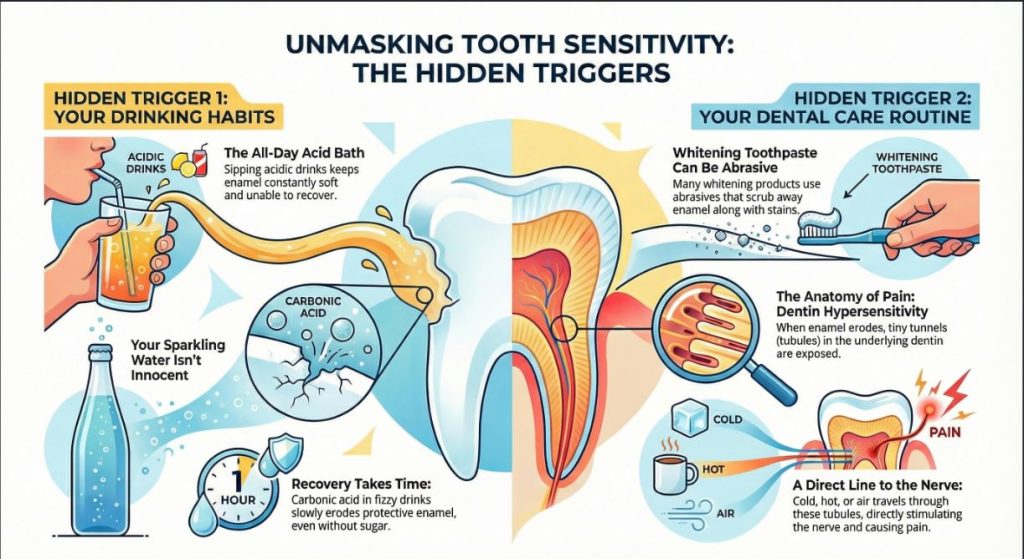
1. The “Sipping” Acid Bath
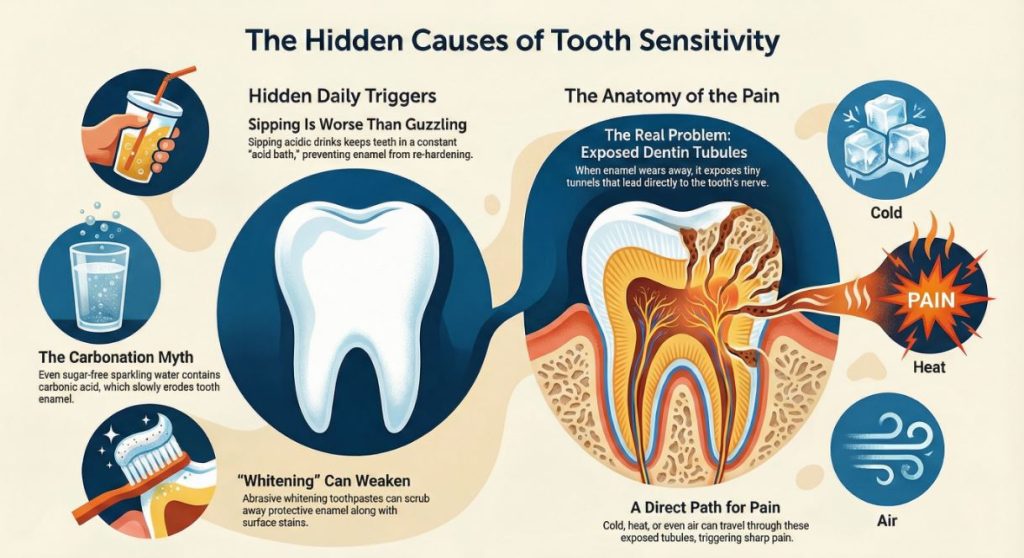
It is not just about the sugar; it is about the duration of exposure. One of the most critical insights we found is that how you drink matters more than the drink itself. A dentist explained that sipping a can of Coke throughout an entire afternoon is significantly worse than guzzling a liter of it in one sitting.
The Science: Every time you take a sip of something acidic (soda, lemon water, juice), the pH in your mouth drops, turning your saliva into an acid bath that softens your enamel. It takes approximately an hour for your saliva to neutralize this acid and re-harden the enamel. If you take another sip 20 minutes later, you reset that clock. You are keeping your teeth in a constant state of demineralization, never allowing them to recover. This “acid bath” erodes the enamel and exposes the sensitive dentin underneath.
2. The Carbonation Myth
You might think you are safe because you switched to sparkling water. You are wrong. While better than sugary soda, carbonated water is still a threat to sensitive teeth. The carbon dioxide dissolved in the water creates carbonic acid, which makes the water acidic.
The Science: This acidity contributes to tooth decay and erosion even in the absence of sugar. If you are addicted to the “kick” of the fizz, you are addicted to a mild acid attack that is slowly stripping away your enamel. While some sources argue the acidity isn’t “that bad,” for someone with compromised dentin, any acid is too much acid.
3. “Whitening” Sandpaper
Go to your bathroom and check your toothpaste. If the tube promises to “whiten” your teeth or contains charcoal, you might be sanding down your own defense system. Whitening toothpastes often rely on abrasives to scrub away surface stains.
The Science: These abrasives don’t just remove coffee stains; they can wear away the enamel, especially if you are brushing too hard. Furthermore, chemical whitening treatments are a known cause of temporary Dentin Hypersensitivity. They open the pores of your teeth to bleach them, which directly conveys the cold sensation to your nerve.
4. The Tubule Exposure (Dentin Hypersensitivity)
You must understand the anatomy of the pain to understand the cure. Under your hard enamel lies a softer layer called dentin. If you looked at dentin under a microscope, you would see a surface full of tiny tunnels called tubules. These tubules connect directly to the nerve in the center of your tooth (the pulp).
When your gums recede or your enamel wears thin, these tubules are exposed to the outside world. Cold water, hot coffee, or even air travels through these tunnels to stimulate the nerve, causing that sharp, shooting pain. The goal of our protocol is not just to “numb” the pain, but to physically plug these holes.
THE PROTOCOL (STEP-BY-STEP)
Stop hoping the sensitivity will just “go away.” It won’t. You need to actively rebuild the mineral layer over your nerves. Execute this routine rigidly for 30 days.
Step 1: The Acid Detox (The “Chug” Method)
For the next 30 days, we are drastically reducing the amount of time your teeth spend in an acidic state.
- The Rule: If it is carbonated, sweet, or acidic (this includes fruit teas and lemon water), it does not touch your teeth without a straw.
- The Technique: Do not nurse your drinks. If you are having a soda or a coffee, finish it in 10 to 15 minutes. Do not sip it for over two hours.
- The Neutralizer: Immediately after finishing your acidic drink, swish your mouth with plain water. This helps wash away the acid and jumpstarts the neutralization process.
- The Wait: Do not brush your teeth immediately after drinking acidic beverages. Your enamel is soft and you will brush it away. Wait at least 45 minutes.
Step 2: Swap the Hardware
Throw away your “medium” or “hard” bristle toothbrush. They are abrasive and are likely contributing to gum recession, which exposes the sensitive roots of your teeth.
- Buy: An ultra-soft toothbrush.
- Technique: No scrubbing. If the bristles on your brush are splaying out after a month, you are pressing too hard. Use a circular motion, massaging the gum line rather than sawing back and forth. The goal is to clean plaque, not sand the floor.
Step 3: The Chemical Reconstruction (nHA & BioMin)
Standard fluoride is good, but for hypersensitivity, we need heavy artillery. We are looking for ingredients that mimic the tooth’s natural structure to block those open tubules.
- The Ingredient: Look for Nano-Hydroxyapatite (nHA) or Bioactive Glass (BioMin F).
- Why nHA? It is a biocompatible material that makes up the majority of your tooth structure. It bonds to the dentin and fills the tubules.
- Why BioMin F? It contains a bioactive glass that dissolves slowly over 12 hours, releasing calcium, phosphate, and fluoride to form a protective fluorapatite layer.
- The Application: Brush for two full minutes, ensuring you cover the sensitive areas near the gum line.
Step 4: “Spit, Don’t Rinse”
This is the most common mistake people make. After you brush with your high-performance toothpaste, spit out the excess foam, but do not rinse your mouth with water.
- Why: Ingredients like fluoride, nHA, and bioactive glass need time to work. If you rinse with water immediately, you are washing away the medicine before it has a chance to bond to your teeth and plug the tubules.
- The Routine: Brush, spit, and walk away. Don’t eat or drink for 30 minutes. Let the minerals cure.
Step 5: The Night Shield
If you wake up with sensitive teeth, or if your sensitivity is generalized across many teeth, you are likely grinding or clenching your teeth at night (bruxism).
- The Damage: Grinding applies massive pressure that causes the neck of the tooth to flex, creating microscopic fractures and popping enamel rods off the tooth near the gum line (abfraction).
- The Fix: Get a night guard. It acts as a shock absorber, stopping the mechanical stress that is shattering your enamel. This treats 99% of sensitive teeth for grinders.
THE REALITY CHECK
This protocol is effective, but it is not magic. It is biology. You need to manage your expectations and watch for warning signs.
1. The Timeline
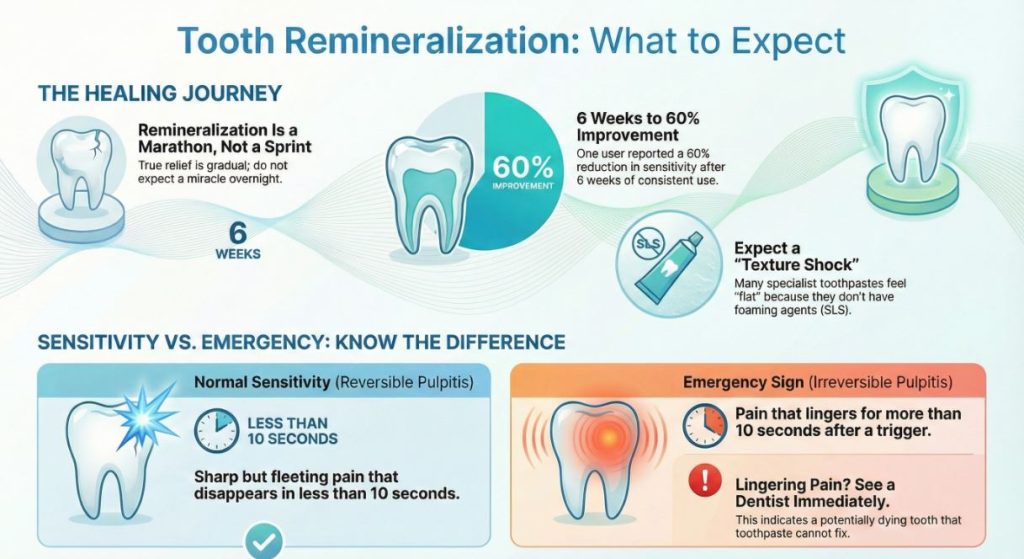
Do not expect a miracle overnight. While some users felt relief in a week, true remineralization and tubule occlusion take time. One user reported that after 6 weeks of using an nHA toothpaste, sensitivity was 60% less, and it continued to improve over a year. Another user with “bad sensitivity” used a remineralizing system and now has none, but it required sticking to the protocol.
2. The “Dying Tooth” Warning
We need to be very clear: there is a difference between “sensitive” and “dying.”
- Reversible Pulpitis (Sensitivity): The pain is sharp but fleeting. It lasts for a few seconds (usually less than 10) after the cold touches the tooth and then fades away.
- Irreversible Pulpitis (Dying Tooth): If the pain lingers for more than 10 seconds—and especially if it lasts for minutes—after the cold trigger is removed, you likely have irreversible pulpitis. This means the nerve is infected or dying. No amount of toothpaste will fix this. You need a root canal. If this is you, book a dentist appointment immediately.
3. Texture Shock
If you switch to nHA or specialist toothpastes, be prepared for a different mouthfeel. Many of these formulations are free of SLS (Sodium Lauryl Sulfate), the chemical that makes standard toothpaste foam up. They might feel “flat” or less bubbly. This is normal.
PRODUCT RECS
We are ignoring the marketing fluff and looking strictly for the active ingredients that have been proven to close dentin tubules and calm nerves.
The Budget Pick (Nerve Calming)
Sensodyne Pronamel / Potassium Nitrate Formulas
- The Mechanism: These toothpastes typically use Potassium Nitrate. This ingredient doesn’t rebuild the tooth; instead, it travels through the tubules to calm the nerve, stopping it from sending pain signals.
- The Verdict: Good for immediate symptom relief, but it stops working if you stop using it.
- Pair With: A soft-bristled brush (like Nimbus or Curaprox) to prevent further abrasion.
If jaw clicking or morning tightness is happening too, see Jaw Clicking & Morning Pain: Understanding Common Causes.
The Splurge (Structural Repair)
BioMin F
- The Mechanism: Uses bioactive glass to release fluoride, calcium, and phosphate slowly over 12 hours. It is designed to bond to tooth enamel and dissolve to form a protective layer.
- User Feedback: Users in the community reported that their sensitivity is “largely gone” using this twice a day.
Boka Ela Mint / Risewell (Nano-Hydroxyapatite)
- The Mechanism: These use Nano-Hydroxyapatite (nHA) to physically plug the open tubules.
- The Verdict: Great for those who want a fluoride-free option that still physically repairs the tooth structure. Note that concentration matters—some users found low-concentration nHA ineffective, while higher concentrations (like in Risewell) worked better.
Prescription Grade
Clinpro 5000
- The Mechanism: A high-concentration fluoride toothpaste is often prescribed by dentists. It delivers a massive dose of fluoride to harden enamel.
- The Verdict: If over-the-counter options fail, ask your dentist for this.
Stop sipping your way to sensitivity. Get the right paste, stop rinsing it off, and give your enamel a fighting chance.
FAQ’S [ People also ask]
You are likely rinsing your mouth with water after brushing. Bioactive ingredients like fluoride or Nano-Hydroxyapatite need time to bond to the tooth structure. To fix this, you must “spit, don’t rinse” to allow the minerals to plug the open tubules.
Yes. Carbonation alone, in the absence of sugar, creates carbonic acid, which will start to eat away at your protective smear layer. You have no choice but to eliminate all carbonated drinks, even unflavored ones, for 30 days.
Yes. Sipping maintains an acidic environment in your mouth for many hours, and your saliva never has a chance to catch up on eroding the pH. Your enamel should consume acids rapidly (within 10-15 minutes), rather than sip all day long.
Absolutely. Most whitening toothpastes contain abrasive agents such as silica or charcoal to scrub off stains that can also erode the enamel and expose the nerves. Use a low-abrasion Nano-Hydroxyapatite toothpaste to regain the surface rather than strip it away.