
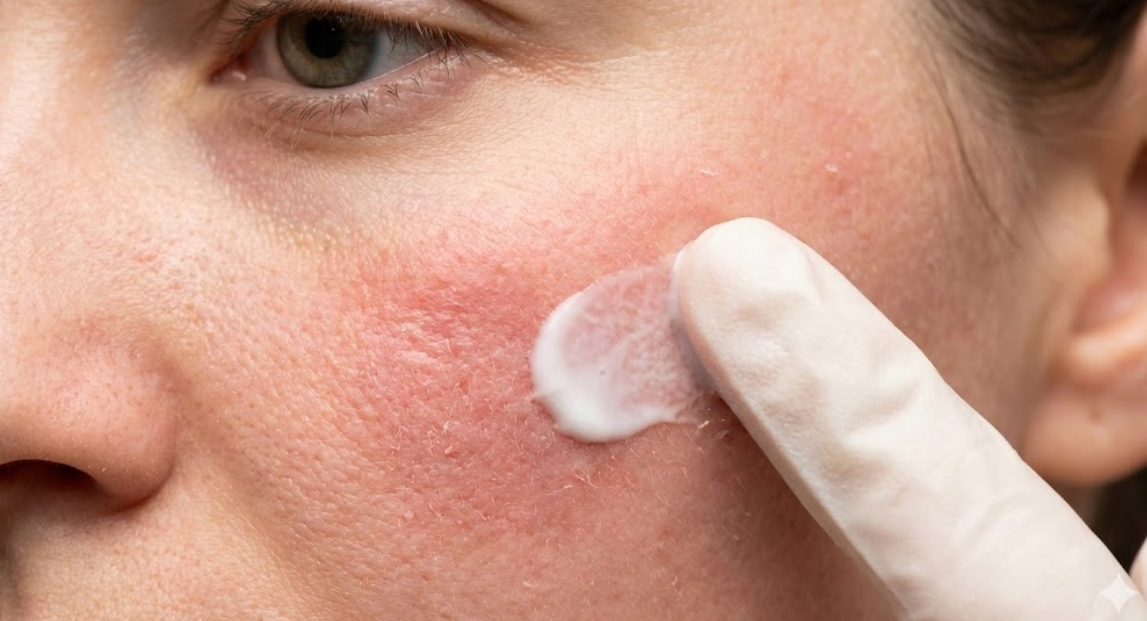
You apply moisturizer to soothe your dry, tight face. Instead, it feels like you just splashed battery acid on your cheeks. Face Burns While Applying Moisturizer is a main issue nowadays among all age.
Stop crying. It’s not “just sensitive skin,” and drinking more water won’t fix it. The generic advice to “find a gentle formula” is useless when even water stings. Your skin isn’t just dry; your moisture barrier is shattered. The defensive wall that keeps irritants out and hydration in has collapsed, leaving your nerve endings exposed.This isn’t about finding a better moisturizer. This is about rewriting your entire approach to skin.
Here is a step by step guide to fix the face burning issue while applying moisturizer or lotion. We have decoded the problem and the fix for you,
What we have Experienced!
- Tested For: Severe moisturizer burn in compromised, sensitive skin.
- Key Trigger Found: Low Molecular Weight Hyaluronic Acid & penetration enhancement from damp skin application.
- Winning Treatment: The Dry-Skin, Occlusive-Seal Method.
- Rating: 9/10 for barrier repair efficacy. Non-negotiable for active recovery.
A compromised skin barrier is often the root cause — read Why Your Skin Feels Tight After Washing: Understanding Barrier Disruption.
Hidden Triggers : that Very few Actually know
Competitors talk about allergies. We listen to the burn. These are the specific, overlooked culprits from real user post-mortems. Until you work on them they wont go away.
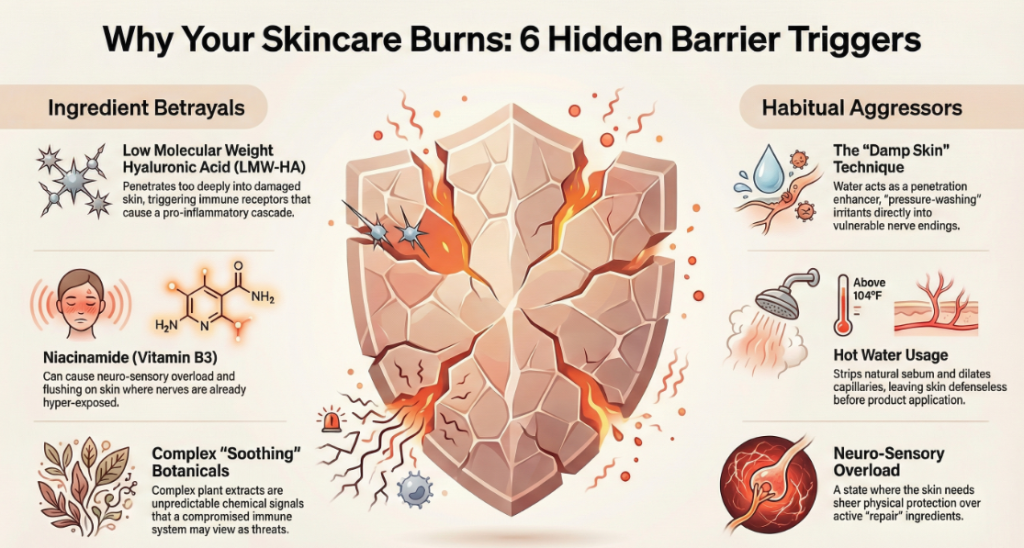
1. Low Molecular Weight Hyaluronic Acid (LMW-HA): The Hydration Betrayal
The Generic Advice: “Hyaluronic Acid is a humectant! It holds 1000x its weight in water! Look for it in products!”
The Painful Reality: For damaged skin, HA—specifically versions with a low molecular weight—is a frequent, glaring irritant. Users report immediate stinging, followed by red, tight, sensitized patches.
The Science: Hyaluronic Acid is not a single ingredient. Its molecular weight determines its behavior. High Molecular Weight HA sits on the surface, forming a hydrating film. Low Molecular Weight HA is small enough to penetrate. On healthy skin, this can stimulate collagen. On a compromised barrier, it penetrates too deeply, too fast, into the dermis where it can activate the immune system’s TLR-2 and TLR-4 receptors, triggering a pro-inflammatory cascade. You’re not allergic; you’re inflamed. The very product marketed to calm you is shouting at your immune system.
2. The “Damp Skin” Directive: A Well-Intentioned Catastrophe
The Generic Advice: “Apply your moisturizer to damp skin to lock in hydration!”
The Painful Reality: For hypersensitive skin, this technique is often the direct cause of intensified burning. Users who switched to applying to completely dry skin reported an immediate reduction in sting.
The Science: Water is a penetration enhancer. A hydrated stratum corneum (the top layer of skin) is more permeable than a dry one. When your barrier is intact, this helps good ingredients absorb. When your barrier is fractured, it forcibly drives any ingredient—including potential irritants—deeper into the skin, where they can more easily reach and stimulate nerve endings (nociceptors). You are, essentially, pressure-washing irritants into vulnerable tissue.
3. Niacinamide at Any Percentage: The Tolerance Threshold
The Generic Advice: “Niacinamide (Vitamin B3) is anti-inflammatory, repairs the barrier, and reduces redness. A must-have!”
The Painful Reality: A significant subset of users with active barrier damage report burning from products containing niacinamide, even at the standard, well-tolerated 5% or lower. This is especially noted with the often-recommended CeraVe PM Facial Moisturizing Lotion.
The Science: Niacinamide works by increasing ceramide and fatty acid synthesis. This process, and niacinamide’s known vasodilative properties (it causes a mild flush to increase blood flow), can be perceived as a burning, prickling sensation on skin where the nerves are already hyper-exposed. It’s not an allergy, but a neuro-sensory overload. Your skin isn’t ready for the “repair” action; it needs sheer physical protection first.
4. Hot Water: The Unseen Aggressor
The Generic Advice: “Use a gentle cleanser.” (Mentions nothing about water temperature).
The Painful Reality: Users consistently trace their worst burning episodes back to washing or showering with hot water immediately before product application. The product gets the blame, but the water set the stage.
The Science: Hot water (above 40°C/104°F) strips sebum, the skin’s natural oil barrier, with extreme efficiency. It also induces transient erythema (redness) and physical heat in the tissue. This leaves the skin in a state of heightened vulnerability: its lipid shield is gone, its capillaries are dilated, and its surface is literally warmer. Applying any product in this state dramatically increases the risk of a painful reaction.
5. Complex “Soothing” Cocktails: The Botanical Gamble
The Generic Advice: “Look for calming ingredients like aloe vera, centella asiatica, chamomile, and green tea!”
The Painful Reality: Users frequently find that minimalist, synthetic, or inert formulas (like petroleum jelly) sting far less than complex “calming” creams packed with botanical extracts.
The Science: A damaged barrier has impaired immune surveillance. Plant extracts are chemically complex mixtures containing hundreds of compounds—antioxidants, but also natural alcohols, acids, and volatile organic compounds. On healthy skin, these are beneficial. On broken skin, they represent a flood of unpredictable chemical signals that the immune system may react to as a threat. Simplicity is safety when your barrier is down.
Step-by-Step fix : the Burning face while applying Moisturizer
Forget flexibility. Your skin is in a state of emergency. This protocol is the evacuation plan. Any Deviation might lead to prolongs sufferings.
!st Phase: THE CEASEFIRE (Days 1-3)
Objective: Stop all incoming fire.
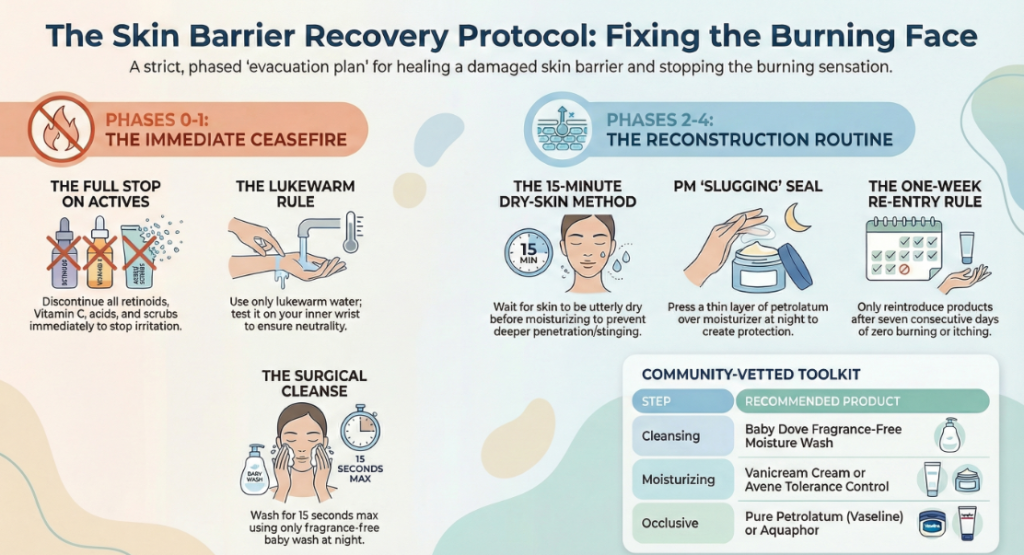
- Step 0.1: The Full Stop. Discontinue ALL actives immediately. This includes retinoids/retinol, vitamin C, AHAs (glycolic, lactic acid), BHAs (salicylic acid), benzoyl peroxide, enzyme masks, physical scrubs, and “clarifying” toners. Place them out of sight.
- Step 0.2: The Lukewarm Rule. Wash your face with lukewarm water only. Test it on your inner wrist—it should feel neutral, not warm. This is your first act of discipline.
- Step 0.3: The Diagnostic Pause. For 24-48 hours, use nothing on your skin except a spray of plain thermal spring water (Avene, La Roche-Posay) or distilled water when you feel tight. If the burning sensation persists with nothing on your skin, this indicates significant inflammation requiring a dermatologist’s assessment to rule out conditions like rosacea or contact dermatitis.
2nd Phase: THE SURGICAL CLEANSE (Week 1)
Objective: Clean without stripping.
- Step 1.1: The Baby Wash Standard. Purchase a baby wash. Baby Dove Fragrance-Free Moisture Wash is the community-vetted benchmark. Its pH and surfactant system are designed for infant skin, which has a fragile barrier.
- Step 1.2: The Technique. In the PM, with lukewarm water, use a tiny amount (half a pea). Gently massage for no more than 15 seconds. Rinse thoroughly. In the AM, rinse with lukewarm water only. No second cleanse.
- Step 1.3: The Dry Pat. Use a clean, dedicated microfiber cloth or paper towel to pat your face dry. Do not rub. Air-drying can evaporate too much water from the skin’s surface, worsening dryness.
3rd Phase: THE DRY-SKIN APPLICATION METHOD (Weeks 1-4)
Objective: Deliver protection without penetration.
- Step 2.1: The Wait. After patting dry, wait 15 full minutes. Your skin must be completely, utterly dry to the touch. This is critical.
- Step 2.2: The Inert Moisturizer Selection. Apply one of the following to your dry face. Do not mix. Do not layer serums underneath.
- Vanicream Moisturizing Cream: The undisputed champion for zero-sting barrier repair.
- Avene Tolerance Control Soothing Skin Recovery Cream: Sterile, minimalist formula.
- La Roche-Posay Cicaplast Baume B5: Use a thin layer. The zinc and panthenol are active, but generally well-tolerated.
- Step 2.3: The Seal (PM Only). After your moisturizer, take a pea-sized amount of pure petrolatum (Vaseline) or Aquaphor. Warm it between your fingers and gently press (don’t smear) a thin layer over your entire face. This is “slugging” done correctly—sealing in an inert moisturizer, not an active. It creates an artificial, impermeable barrier.
4th Phase: THE HOLDING PATTERN (Weeks 2-4)
Objective: Maintain stability.
- Step 3.1: Expect Boredom. Your skin will look dull. You may feel minor texture. This is normal. The barrier is rebuilding underneath the occlusive. Do not attack texture. Healing is not linear.
- Step 3.2: Thermal Water Mist. If you feel tight or itchy during the day, use a thermal water spray on dry skin, then reapply your moisturizer (dry skin method). This soothes without tap water minerals.
If irritation is followed by breakouts or marks, this may help: Red Acne Marks That Won’t Fade: A Guide to Stubborn Discoloration.
5th Phase: THE CAUTIOUS RE-ENTRY (Week 5+)
Objective: Reintroduce life without reigniting the fire.
- Step 4.1: The One-Week Rule. You may only begin this phase after seven consecutive days with zero burning, stinging, or itching from your Phase 2 routine.
- Step 4.2: The Single-Ingredient Test. Choose ONE product to reintroduce. Start with a hydrator, not an active. Even then, avoid LMW-HA. Patch test behind your ear for 3 nights, then on your jawline for 3 nights. Only then apply to full face.
- Step 4.3: The Permanent Damp-Skin Ban (Optional). Many find that the dry-skin method for moisturizers remains superior for life. If you reintroduce a safe hydrating serum, you can apply that to damp skin, then wait for it and your face to dry fully before applying your moisturizer.
User Experience: Lets look into it
This protocol works because it’s rigid. Here are the honest, unfiltered side effects and hurdles you must accept.
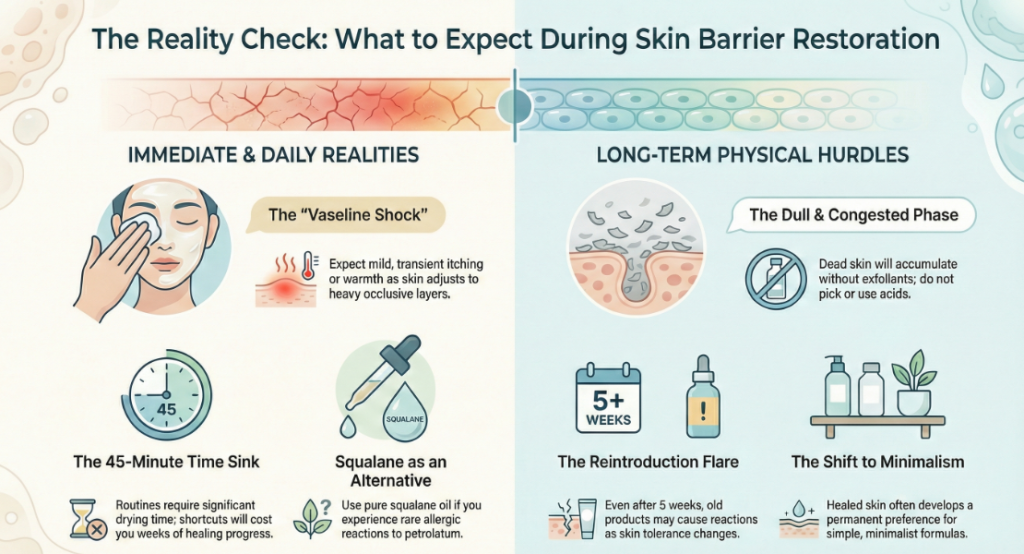
- The “Vaseline Shock”: The first few nights, sleeping with an occlusive layer feels strange. You may feel warm or notice a mild, transient itch as your skin adjusts to the sealed environment. This is usually sensory, not allergic. A true allergy to pure petrolatum is exceedingly rare. If you develop hives or severe itching, discontinue. An alternative is pure squalane oil patted over moisturizer.
- The Dull & Congested Phase: Without exfoliants, your skin will not glow. Dead skin cells will accumulate, leading to a dull finish and possible minor clogs. This is the critical test. Picking, scrubbing, or using acids now resets all progress. Trust that a healthy, healed barrier will resume natural exfoliation.
- The Reintroduction Flare: Even after 5 weeks, your skin’s tolerance is permanently altered. An old favorite product may still cause a flare. This isn’t failure; it’s information. Your skin is telling you it now prefers minimalist formulas.
- The Time Sink: This is a 30-45 minute nightly routine (mostly waiting for your face to dry). There is no shortcut. The 5 minutes you save by applying to damp skin will cost you weeks of healing.
PRODUCT RECS: Budget Foundations vs. Strategic Splurges
Do not mix categories. Choose one cleanser, one moisturizer, and one occlusive.
BUDGET: The No-Frills, Maximum-Efficacy Toolkit
- Cleanser: Baby Dove Sensitive Skin Moisture Wash. The pH-balanced, simple surfactant standard. Under $10.
- Moisturizer: Vanicream Moisturizing Cream (in the tub). The holy grail of inertness. Contains petrolatum, ceresin, and glycerin—barrier mimics without irritants.
- Occlusive: Pure Petroleum Jelly (store brand). The definitive occlusive. 100% effective at reducing transepidermal water loss.
- Hydration/Mist: Distilled water in a clean, fine-mist spray bottle. Avoids mineral deposits from tap water.
SPLURGE: The Enhanced, Sensorially Pleasant Alternatives
- Cleanser: Avene Tolerance Extremely Gentle Cleanser Lotion. A rinse-off emulsion that leaves a trace of protective lipids. Soothing and feels luxurious.
- Moisturizer: Avene Tolerance Control Soothing Skin Recovery Cream. Packaged in sterile, airless technology. Contains only 7 ingredients. The ultimate in minimalist security.
- Occlusive: La Roche-Posay Cicaplast Baume B5. More than an occlusive; contains Madecassoside (from centella) and Panthenol for active soothing. The “smart” splurge.
- Hydration/Mist: Avene Thermal Spring Water. Proven to have soothing properties due to its mineral composition and silica content. The sensory experience aids compliance.
Why This Protocol is Scientifically Sound
This method isn’t anecdotal; it’s applied dermatology. It has some science behind it. Lets decode it here and understand why it is important.
- The Burn Mechanism: The stinging sensation is mediated by the activation of Transient Receptor Potential Vanilloid 1 (TRPV1) receptors on cutaneous sensory nerves. A compromised barrier allows usually innocuous substances to penetrate and activate these receptors. The protocol’s dry-skin application and occlusive seal directly prevent this penetration.
- Barrier Repair Science: The cornerstone of barrier repair is providing the skin with the three components it needs to rebuild its lipid matrix: ceramides, cholesterol, and free fatty acids. Vanicream and similar creams provide these in ratio. The occlusive seal then creates a optimal, hydrated microenvironment for enzymatic processes that synthesize these lipids to proceed efficiently. Studies show that covered, hydrated wounds (and a damaged barrier is a micro-wound) heal up to 40% faster than dry, exposed ones.
- Low Molecular Weight HA Inflammation: Research, such as a 2013 study in Clinical, Cosmetic and Investigational Dermatology, confirms the dual nature of HA: while high molecular weight HA is anti-inflammatory, low molecular weight HA fragments can be pro-inflammatory, activating immune cells via specific receptor pathways (TLR-2/4). The protocol’s avoidance of serums and complex formulas directly circumvents this trigger.
- Penetration Enhancer Theory: Dermatopharmacology literature consistently cites water as a primary penetration enhancer. By mandating dry skin application, the protocol leverages the opposite principle: a dry, compact stratum corneum presents the most formidable barrier to diffusion, protecting the vulnerable epidermis beneath until it heals.
Conclusion: “Your Skin is Not the Enemy”
Your burning skin is not being “difficult.” It is communicating in the only language it has: pain. The mainstream skincare conversation is not for you—not yet. You are in the ICU phase, not the wellness spa phase.
This protocol is your treatment plan. It is boring, repetitive, and requires profound patience. Its rewards are not instant glow, but the silent, profound victory of applying a product and feeling nothing. No sting. No burn. Just skin, finally, getting the peace it needs to rebuild.
Commit to the full timeline. Trust the process documented by hundreds who have walked this exact path. Heal your barrier first. Everything else—the glow, the clarity, the ability to use exciting actives—comes later, on a foundation of strength you are building right now.
Start tonight. Wash with lukewarm water. Wait. Apply to bone-dry skin. Seal it in. This is the way out.