
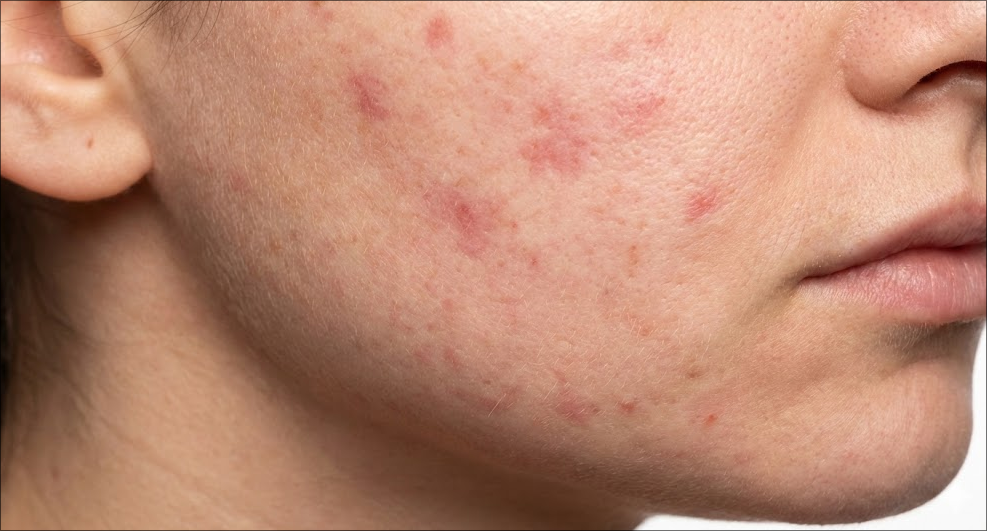
Coping with a breakout is hard enough. This is often even more aggravating than when the active acne goes away, but you are left with a flat, red mark that remains for months and seems completely unaffected by your skin-care routine. You could also be googling something like how to remove red acne scars that won’t go away, only to find advice that doesn’t quite line up with what you see in the mirror.
This is a common occurrence, and as I know first hand, it can be an incredibly disheartening one often indicating a certain type of post-acne mark that behaves very differently than your regular old darkspot.
Understanding why these marks persist is the first step toward managing them effectively. This guide explains the biology behind stubborn discoloration, clarifies the critical differences between mark types, and outlines a rational approach focused on skin health and informed choices.
Hormonal breakouts are one of the most common causes of lingering redness — learn more in Why Does Acne Get Worse Before Your Period?
What Are These Stubborn Red Acne Marks? (PIE Explained)
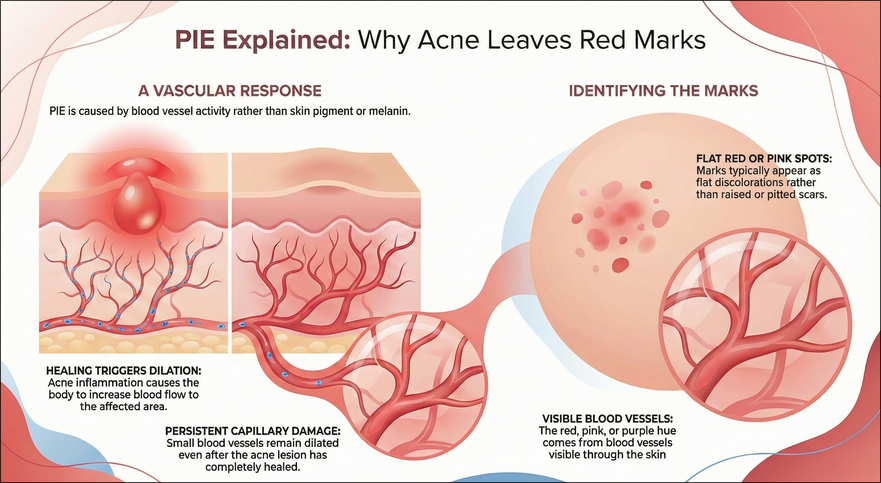
The medical name for these long-lasting red or pink marks is Post-Inflammatory Erythema (PIE). It is a vasoconstrictive response, not pigment. Here’s what happens:
When a nasty inflammatory acne lesion (like a papule, pustule, or cyst) is on the mend, the body revs up the healing process by sending more blood to the affected area. Trouble is, this extra blood flow can cause the teeny tiny capillaries just beneath the skin to get a bit too big for their britches – that is, they dilate.
Sometimes this dilation, or more often than not, some minor damage to the capillary walls just hangs around long after the acne itself has finally disappeared. And the result is that you’re left with a flat red patch, pinkish in some cases, or a weird purplish hue – basically a big red flag that lets everyone know the blood vessels are still visible right through your skin.
PIE vs PIH: Where the Problem Lies
There’s a major reason why all those scar-fading tips and tricks people dish out so freely often fall flat, and it’s because most people get these two totally different conditions mixed up:
- Post-Inflammatory Erythema (PIE): You know the look – red, pink, or a weird purplish color. It’s all down to blood vessels that are just a bit too dilated or damaged.
- Post-Inflammatory Hyperpigmentation (PIH): This one shows up as brown, tan, or gray – and it’s caused by the body crankily producing too much melanin during the healing process.
If you grab a product designed to stop melanin in its tracks (like a vitamin C serum for PIH) and apply it to a red mark that’s nothing more than dilated blood vessels (a PIE) you’re basically throwing your money out the window. And that’s why so many people find that their red acne marks just won’t budge despite doing everything right in their skincare routine.
Why Do These Red Marks Refuse to Fade?
PIE’s refusal to budge has its roots in skin biology. You see, the upper layers of the skin – those pesky surface-level skin cells or excess pigment – get gradually sloughed off and replaced. But down at the level of blood vessels, things are a bit more set in their ways.
- why it takes so long to get rid of PIE: The melanin that causes the discoloration of PIH is just carried upward to the surface as the skin sheds its cells, but blood vessels don’t have a ‘shedding’ process like the rest of the skin does. Once those vessels are dilated they don’t just shrink back down to normal size without some serious effort
- a low-level undercurrent of inflammation: That skin around the mark will often be in a bit of an inflammatory state which is a big part of why the capillaries don’t just calm down & get back to normal.
- things that can make things worse: Sunlight is probably the biggest thing to make PIE worse. UV radiation can make the redness look even worse and amplify that low-level inflammation. So essentially you’re looking at a potentially prolonged stay for that redness. so it does seem like those acne red marks will stick around forever
Deep, painful blemishes can also increase your risk of post-acne marks — see Chin Pimples: Why They Hurt and How to Care for Them.
Common Factors That Make PIE Worse
- Fiddling or Squeezing at your spots: This tends to really ramp up the trauma and inflammation – which is when PIE starts to get properly nasty.
- Using products that strip your skin dry: You’re basically taking away your skin’s best chance to heal itself and that’s just going to make it harder for your skin to recover.
- Neglecting sun protection: Let’s face it, if you’re letting the sun get to your skin, you’re undoing all the effort you’re putting in to get rid of that redness
Why Your Current Products Might Not Be Working
If you’re struggling with red acne marks that just won’t budge, it’s worth thinking about why all the usual suspects don’t quite make the grade:
- Salicylic Acid & Benzoyl Peroxide: Great at clearing up active breakouts and are excellent for exfoliating pores and killing off bacteria – but as far as PIE goes, they’re really not going to do much. They don’t target the blood vessels that cause the redness.
- Vitamin C, Azelaic Acid, Kojic Acid: Really good at fading those nasty brown spots by messing with melanin production – but PIE is a different beast altogether. They’re not designed to constrict the capillaries that are causing all the trouble – although some, like azelaic acid, might have a bit of a secondary anti-redness effect.
- Retinoids (Retinol, Prescription Strengths): Pretty good at giving you some smoother, healthier looking skin, and can even help with that PIH – but they’re not going to directly tackle the vascular issues that are causing all the redness. They might indirectly help by helping your skin repair itself over time, but that’s not the same as actually treating the underlying problem.
This doesn’t mean these ingredients are ineffective—they are pillars for preventing acne and treating PIH. It explains why they shouldn’t be your only strategy for persistent red marks.
A Supportive Approach to Marks That Persist
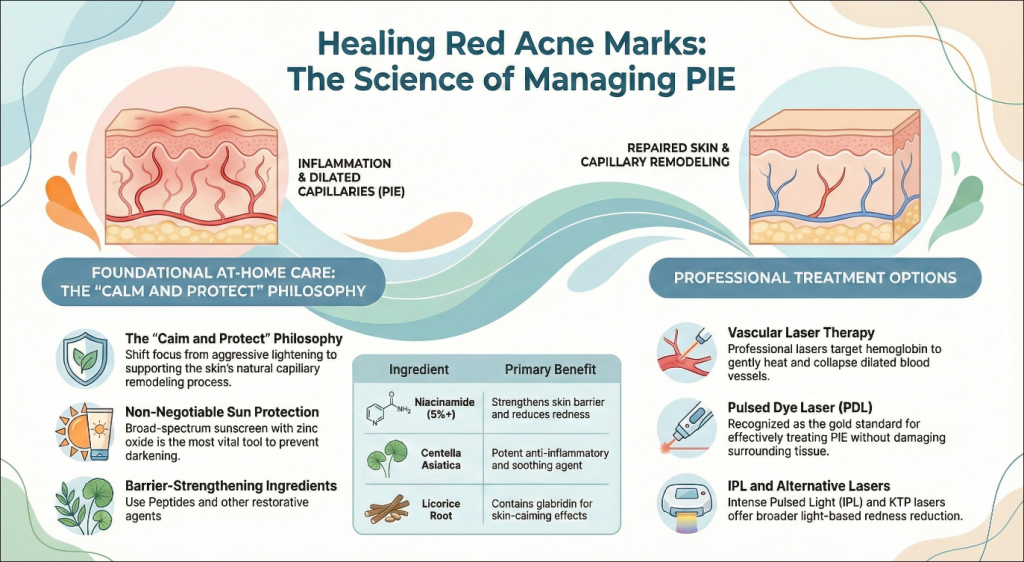
Managing PIE requires a shift from “lightening” to “calming and protecting.” The goal is to support the skin’s environment so it can facilitate the natural remodeling of those dilated capillaries.
Foundational Skin Care for Red Marks
This trio is non-negotiable – it’s the foundation on which any effective skin care approach is built:
- Cleansing and Keeping Your Skin’s Barrier Intact: Use a gentle cleanser that won’t strip your skin, and follow it up with a repairing moisturizer. A healthy skin barrier acts as a sort of shock-absorber, keeping a lid on background inflammation.
- Using a Daily Sunscreen That Protects from All Angles: The single most important product for preventing PIE from getting darker and more entrenched is a good broad-spectrum sunscreen – look for one that includes calming ingredients like zinc oxide to boot.
- Taking Care of Your Skin with Acne Treatments: Don’t let new breakouts pop up – and make sure to use your acne treatments with care so you don’t end up drying out or irritating your skin in the process.
Ingredients That Can Help Soothe and Support
Take a look at products containing these super-calming, skin-friendly agents:
- Centella Asiatica (Cica) and Madecassoside: This duo is a potently soothing and anti-inflammatory pair.
- Niacinamide (5%+): This one is a bit of a multitasker – it can help strengthen your skin’s barrier, and reduce redness over time too.
- Licorice Root Extract: That contains glabridin, which is a skin-soothing superstar.
- Peptides: They’ve been shown to help support overall skin repair and resilience.
- Zinc Oxide: Whether you’re using it in sunscreen or a cream, it’s a gentle protective agent that’s great for soothing the skin.
Professional Treatment Options
PIE is all about the structures under the skin’s surface, so the most effective approaches are usually the ones that get done in a doctor’s office – by a dermatologist or licensed professional. They can target the red blood vessels deep down.
- Pulsed Dye Laser (PDL): This one’s often the gold standard for treating PIE – it targets and gently heats up the red blood vessels without hurting the surrounding skin.
- Intense Pulsed Light (IPL): A bit broader in its wavelength, so you’ve got some flexibility in terms of what it can target with some filtering.
- Other Vascular Lasers: There are other lasers out there, like KTP and Nd:YAG, that can be dialed in for vascular concerns.
Important note: Any of these procedures will require a consultation with someone who knows what they’re doing – someone who can take a good hard look at your skin and give you a solid assessment your skin type and the specific marks to ensure safety and efficacy, especially for darker skin tones.
When to Consult a Dermatologist About Persistent Marks
Seeking professional medical advice is recommended if:
- You are unsure whether your marks are PIE, PIH, or textured scars.
- The marks are severe, widespread, or cause significant distress.
- You have persistent active acne that needs management.
- You have followed a consistent, supportive skincare regimen for 4-6 months with no perceived improvement.
Also Read : Hard Painful Lump Under Skin on Chin: Causes and Care Explained.
- You wish to explore whether laser or light-based treatments are a suitable option for you.
Frequently Asked Questions
Q: How long do red acne marks (PIE) last compared to brown marks (PIH)?
A:PIH can gradually start to fade away in a few months right up to a few years as your skin sheds off that extra pigment. On the other hand, PIE (redness caused by blood vessels) tends to stick around – a lot longer than people expect – sometimes up to a year or even more if left unattended. That’s why a lot of people feel like their red acne marks are just never going to budge
Q: Can a mark be both red and brown?
A : Absolutely – yes, that’s possible. It’s not uncommon for some red marks from PIE to be sitting on top of brown spots from PIH. So in these cases you’ll probably need to be attacking the problem from two fronts – calming the redness and dealing with the pigmentation issue too.
Q: Are there any overnight treatments for PIE?
A : Sorry to burst your bubble but, generally, the answer’s no. You need to be cautious of any claims that say you can get rid of PIE overnight – it just doesn’t work that way. Properly managing PIE really does require patience and consistency with things like sun protection, gentle skin care, and if you do choose to get professional help, be aware that those treatments will have a healing time too.
Q: Is PIE a form of scarring?
A : No. True acne scars are raised or sunken – they are textural changes in the skin. PIe is flat red discoloration that is caused by inflammation. Even though it’s not a scar it can still exist with scarring – the two can go hand-in-hand.
Q: Does moisturizing help fade red marks?
A: Absolutely. A well-hydrated, strong skin barrier is less inflamed and more resilient. Using a good moisturizer creates a better environment for redness to subside and prevents further irritation.
Conclusion: Clarity Over Quick Fixes
The journey with red acne marks that won’t fade is often one of patience. The key is recognizing Post-Inflammatory Erythema for what it is: a vascular response that requires a different strategy than pigment-based marks. Success lies not in seeking a single miracle product but in committing to foundational practices—meticulous sun protection, gentle acne prevention, and barrier-supporting skincare. For many, this consistent care creates the ideal conditions for gradual improvement. For others, professional treatments offer a more direct path. By prioritizing understanding and skin health, you can move forward with realistic expectations and make confident, informed decisions about your care.
Disclaimer: This article is for educational purposes only and does not constitute medical advice. It is not a substitute for professional diagnosis or treatment. Always consult a qualified healthcare provider, such as a board-certified dermatologist, with any questions regarding a skin condition.