
For anyone looking for skincare advice, the separation between a “morning routine” and a “night routine” is always a pain point. You might be wondering why can’t i just do the same thing twice a day? The answer lies not in marketing, but in biology of your body and environment.
The challenges that you skin faces between day and night are fundamentally different. A thoughtful routine aligns with these shifts, working with your skin’s natural rhythms rather than against them. This guide moves beyond generic product lists to explain the core purposes, scientific principles, and strategic thinking behind morning and evening skincare.

Why It Is Necessary to Build Saperate Routine For Morning and Night
In simple words, the distinction is this:
- Morning Routine = Defense and Preparation. This is the time of day when you protect your skin from environmental aggressors and prepare if to endure all day long envirnmental factors.
- Night Routine = Repair and Recovery. Its primary role is to aid the skin’s natural renewal processes that peak while you sleep, addressing concerns and restoring balance.
You can think it like a cycle, in the morning you put on protective gear (like shoes and clothing) before heading out. At night, you unwind, repair, and rest. Your skin benefits from a similar cycle of preparation and recovery.
If small breakouts keep forming around your mouth, this may help:
Small Pimples Appear Around Your Mouth: Cause & Prevention.
Breaking Down the Morning Routine: Your Daily Shield
The daytime is when your skin is in “active duty” mode. Our focus should not be aggressive treatment, but wise protection and maintenance.
The Non-Negotiable Core: Cleanser, Antioxidant, Sunscreen
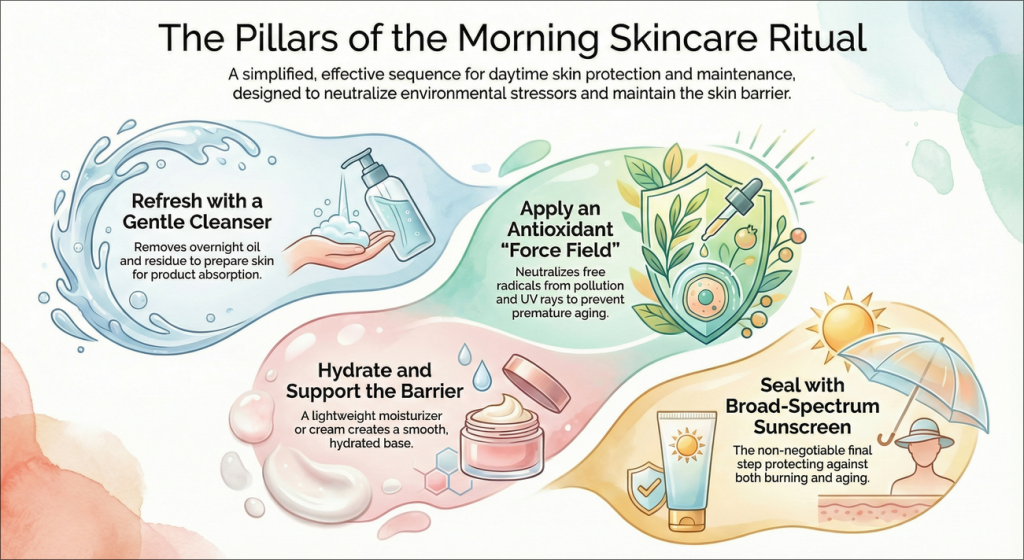
A highly effective morning routine can be elegantly simple, built on three pillars:
- Gentle Cleanser: Overnight, your skin sheds cells and produces sebum (oil). A mild, non-stripping cleanser removes exis dirt and preps the skin to absorb subsequent products better than only water. The goal is refreshment, not a deep purge.
- Antioxidant Serum (The Key Upgrade): This is where your routine becomes proactive. Antioxidants like Vitamin C, Niacinamide, or Ferulic Acid neutralize free radicals—unstable molecules generated by UV rays and pollution. Think of them as a protective force field under your sunscreen, reducing oxidative stress that leads to premature aging and dullness.
- Moisturizer (If Needed): This hydrates and creates a smooth base. For oily skin, a lightweight lotion or gel may suffice; drier types may need a cream. Its job is also to support the skin barrier.
- Sunscreen (The Ultimate Defender): This is the single most crucial step in any morning routine. Broad-spectrum SPF 30+ (or higher) is non-optional. It protects against UVB rays (which cause burning) and UVA rays (which cause aging and penetrate glass). Sunscreen is the final, essential sealant over all your other steps.
Why This Order? You apply thinnest to thickest texture for optimal absorption. The antioxidant goes on clean skin to get the most benift, then a moistureizer is used for hydration, and topped with sunscreen as the final protective film.
Demystifying the Night Routine: The Science of Skin Repair
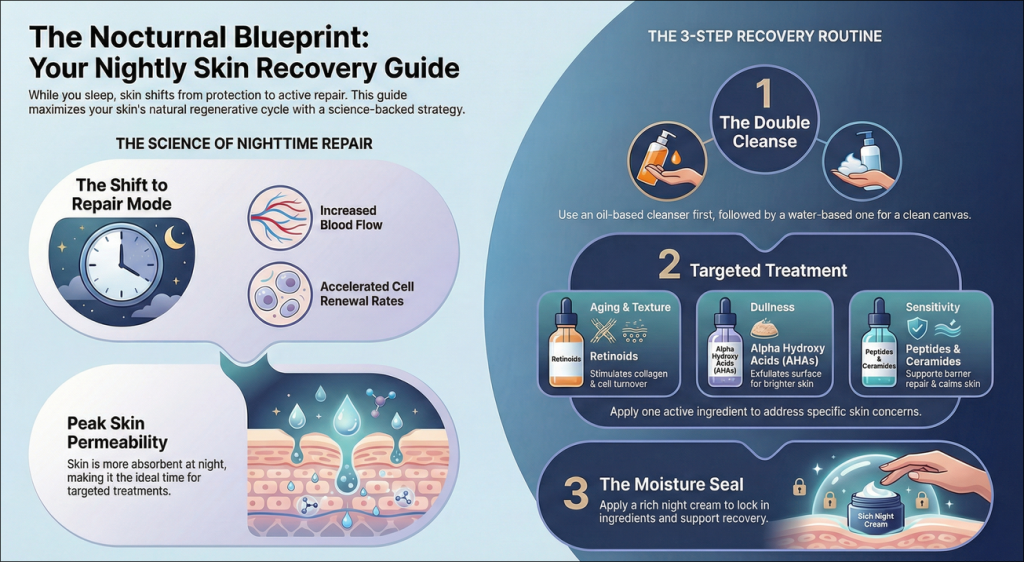
Night is the time when your skin resides in repair mode. The blood flow increases, cell renewal rates accelerate, and the skin’s permeability shoots up, which makes This makes night an ideal time to deliver targeted ingredients.
Double Cleanse, Treatment, Moisturize
The evening is for addressing the damage you took throughout the day.
- First Cleanse (Oil-Based/Balm/Micellar Water): This step breaks down and removes sunscreen, makeup, excess oil, and pollutants that water-based cleansers can’t fully tackle. It’s essential for the next steps.
- Second Cleanse (Gentle Water-Based Cleanser): This washes away residue from the first cleanse and cleans the skin itself. Together, this “double cleanse” ensures no barriers exist between your skin and the treatment products to follow.
- Treatment Products (The Targeted Step): This is where you personalize. The key is to introduce one active ingredient at a time and use it consistently.
- For Congestion & Aging: Retinoids (like retinol) are the gold standard. They promote cell turnover, improve texture, and stimulate collagen. They make your skin more sun-sensitive, which is why they are strictly for nighttime.
- For Dullness & Hyperpigmentation: Alpha Hydroxy Acids (AHAs like glycolic or lactic acid) exfoliate the surface, revealing brighter skin. Use them on alternating nights from retinoids to avoid irritation.
- For Barrier Repair & Calming: Ingredients like peptides, ceramides, or Centella Asiatica support the skin’s repair processes and soothe sensitivity.
- Moisturizer or Night Cream: A richer moisturizer at night helps seal in all the treatment ingredients, provides lasting hydration, and supports the skin’s recovery process as you sleep.
Why This Order? Cleanse thoroughly to remove barriers. Apply treatment serums to clean, dry skin for maximum penetration. Seal everything in with a moisturizer.
Common Mistakes When Preparing Morning Vs Night Skincare Routine & How to Avoid Them
Understanding the “why” helps you avoid these common pitfalls:
- Doubling Up Unnecessarily: Using the same active ingredient (like a Vitamin C serum or a retinoid) both morning and night is often overkill and can compromise your barrier. Pick one strategic time for each active.
- Skipping Morning Antioxidant: We should not just use sunscreen. This is because sunscreen alone is not enough to protect our skin. The morning antioxidant helps a lot. It is like a helper that stops bad things from hurting our skin.
- Using “Night” Products in the AM: When you use “Night” products in the morning it can be a problem. These products are often called “night” products because they have things like retinol in them. This means they can make your skin sensitive to the sun. They can also be too thick to wear under sunscreen and makeup during the day.
- Overcomplicating the Routine: The thing about routines is that they do not have to be complicated to be good. More steps in a routine do not mean that the results will be better. A routine that is simple and consistent and that focuses on the steps is really what works best.
- Neglecting the Neck & Chest: These areas have thinner skin and are highly exposed to the sun and environment. Extend your morning and night routine down to your décolletage.
Dealing with chronic dryness or irritation? Start here: Dry Itchy Skin Patches: The Actual Problem and Cure.
When to Seek Professional Guidance
Having an understanding of routines can be really helpful but a dermatologist or licensed aesthetician is the person you should talk to for personalized care that is just right, for you. You should think about talking to an if:
- If you have a skin problem, like rosacea or bad acne or eczema that will not get better you should do something about it. Over the counter products do not work for your skin condition. You have rosacea or severe acne or eczema. It is still a problem.
- You are unsure about which prescription-strength actives (like tretinoin or hydroquinone) might be appropriate for you.
- When you use products that cause irritation and does not go away or you feel a stinging sensation or your skin turns red, this are signs that your skin barrier is not working properly and perhaps damaged. Also one more possibility is that you have sensitivity to products.
- You want to know what your skin needs and what is going on with it. You need an assessment that is just, for your skin and its own unique problems.
A professional can provide diagnosis, prescribe treatments, that suits your skin and purpose.
Frequently Asked Questions (FAQ)
A: Yes, if it’s a formula that works well under your sunscreen in the AM and provides enough hydration for you at night. Many people prefer a lighter lotion for day and a richer cream at night to support recovery, but it’s not a strict rule. Listen to your skin’s needs.
A: For some skin types, yes. This is called the “water rinse” method and can be beneficial for very dry or sensitive skin to avoid over-stripping. However, if you used occlusive products (like heavy creams or ointments) overnight or have very oily skin, a gentle cleanse is advisable to ensure proper product absorption.
A: Sunscreen. It is the unequivocal, non-negotiable star of the morning routine. Conversely, treatment actives like retinoids and exfoliating acids are the stars of the night routine, as they can make skin more photosensitive and work in sync with the skin’s repair cycle.
A: A brief wait of 60-90 seconds for the serum to absorb is sufficient for most products. The goal is to let it dry down slightly so it’s not immediately diluted by your moisturizer. You don’t need to wait for it to be completely “soaked in.”
A: For sensitive skin, simplify: Morning protects (gentle cleanse, soothing serum, moisturizer, sunscreen). Night repairs (double cleanse, ceramide moisturizer). Prioritize barrier support with minimal steps.
A: Apply eye cream after your serums and before your moisturizer. Use your ring finger to gently pat a small amount (about a grain of rice for both eyes) around the orbital bone, avoiding direct dragging on the eyelid.
Conclusion
Building a skincare routine is not just about buying a lot of products. It is really about knowing what you are doing. You should have one routine for the morning and another for the night. This makes sense because your skin does things at different times. During the day your skin needs to be protected. At night your skin needs to repair itself. Your skincare routine should do these things for your skin. Building a skincare routine like this is important for your skin. Skincare is, about taking care of your skin and this is a big part of it.
You need to start with the basics. Learn how your skin works and what can go wrong with your skin. Every morning you should use antioxidants and sunscreen to protect your skin. At night you should clean your skin. Help it recover. Once you do these things every day you can try skin treatments. See how your skin does over a weeks. Do not just look at how your skin does after a days. Taking care of your skin is something you do every day for a time. It is not something you do quickly because you are, in a hurry. Your skin needs care to be really healthy. By aligning your routine with your skin’s natural rhythms, you empower yourself to make choices
Disclaimer: This article is for educational purposes only and is not intended as a substitute for professional medical advice, diagnosis, or treatment. Always seek the advice of your dermatologist or other qualified healthcare provider with any questions you may have regarding a skin condition. Never disregard professional medical advice or delay seeking it because of something you have read here.