
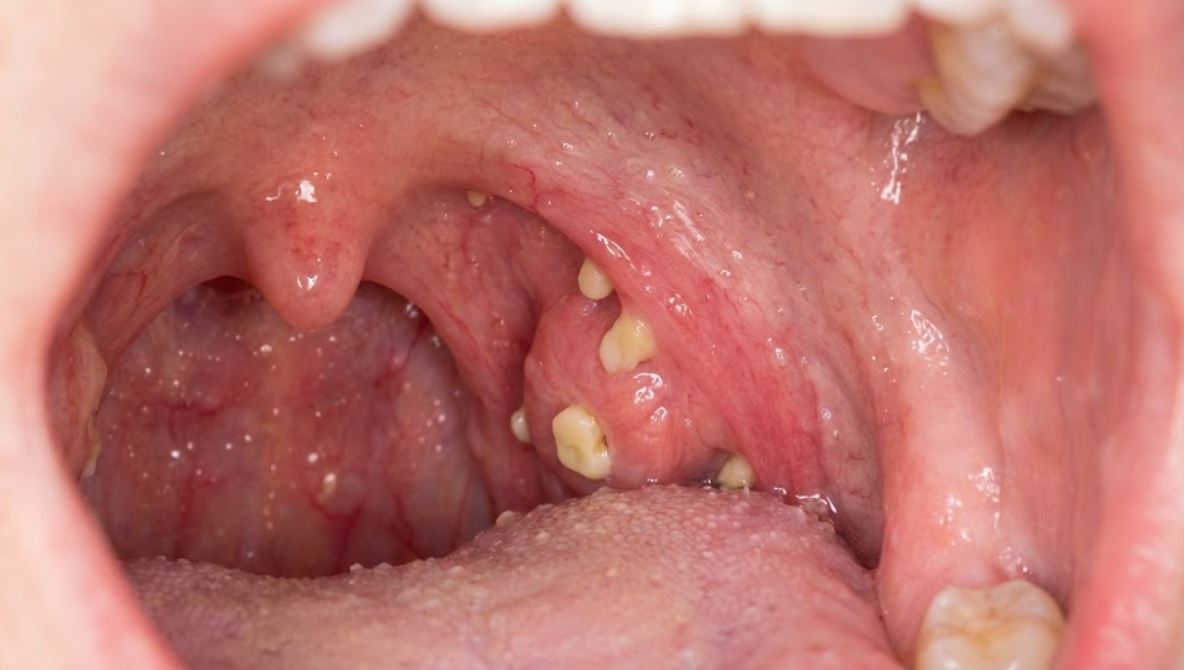
You recognize the smell before you see it. That faint, cloying odor of decay that hangs on your breath after you’ve brushed your teeth for the hundredth time. Perhaps there’s a scratchy, foreign object in the back of your throat, like a popcorn kernel that won’t go down. You shine a flashlight works best) down your throat and look in the mirror as you open wide, and there it is: a light-colored, rock-hard lump stuck in the crevices of your tonsils.
If you have found yourself Googling “white chunks in throat that smell bad,” you have likely already encountered the standard, patronizing medical advice. Doctors will often tell you to “improve your oral hygiene” or “drink more water”. This is useless fluff. You are not dirty. You are dealing with tonsil stones (tonsilloliths), a biological glitch where your body’s own defense mechanisms turn against you.
At Skinzenic, we don’t do fluff. We don’t tell you to “reduce stress” to cure a physiological blockage. We dug through medical literature and hundreds of user logs to find what actually dislodges these calcified nightmares without resorting to surgery that feels like swallowing razor blades.
THE EXPERIENCE BOX
| Field | Result |
| Tested For | Chronic Halitosis & Throat Discomfort |
| Key Trigger Found | Dairy, Nuts & Deep Tonsil Crypts |
| Winning Treatment | Curved Irrigation Syringe + Salt Water |
| Rating | 9/10 (Requires consistency) |
THE HIDDEN TRIGGERS
Forget the generic “poor hygiene” diagnosis. You can brush three times a day, floss religiously, and still produce stones the size of peas. Why? Because tonsil stones are not just old food; they are a complex calcification of minerals, dead cells, and bacteria that get trapped in your anatomy. Here is what is actually happening in your throat that the competitors missed.
If lingering bad breath is your main concern, start with Bad Breath That Won’t Go Away? Why Home Fixes Fail.
1. The Dairy & Calcium Connection
This was the most common dietary trigger reported by real-world sufferers, yet it is rarely mentioned in basic health articles. Users consistently found that consuming dairy products—specifically milk, cheese, and whey protein—accelerated the formation of stones.
The science is there to back this up: Tonsil stones are largely composed of calcium salts. Dairy is high in calcium and also naturally thickens mucus. When you eat dairy, especially at night before you go to bed, there is a good likelihood you are in effect painting your tonsils with the raw material required to produce stones. If you are chugging whey protein shakes, or eating cheese late at night, you are feeding the problem.
2. The “Crypt” Anatomy
You aren’t dirty; you just have “craggy” tonsils. Your tonsils are not smooth surfaces; they are covered in pits and crevices called “crypts”. In some people, these crypts are shallow. In others, they are deep, cavernous pockets that act like a net, trapping food particles, dead tissue, and bacteria.
Once debris enters these deep pockets, it cannot easily be swallowed away. It sits there, rotting and calcifying over time. If you have a history of tonsillitis or throat infections, your tonsils likely have even more scar tissue and deeper pits, making you a prime candidate for chronic stones.
3. Post-Nasal Drip and Allergies
Your nose is a stone factory. Excess mucus dripping down the back of your throat (post-nasal drip) is a primary contributor to stone formation. This mucus accumulates in the crypts while you sleep. If you suffer from seasonal allergies or chronic sinus issues, your body is constantly dumping mucus into your tonsils, where it hardens into white chunks.
THE PROTOCOL (STEP-BY-STEP)
Stop poking your throat with a sharp fingernail or a bobby pin. You will cause bleeding, infection, and potentially damage the delicate tonsil tissue. We have synthesized a rigid removal and prevention protocol based on the most effective tools found in our research.
Step 1: The Soften Phase
Before you attempt to remove a stone mechanically, you must loosen the tissue. Dry, tight tonsil tissue will bleed if you poke it.
- Action: Gargle vigorously with warm salt water.
- Recipe: Dissolve half a teaspoon of salt in a cup of warm water.
- Why: The saline solution helps dislodge the stones from the back of the throat, reduces inflammation, and helps eliminate odor.
- Frequency: Do this morning and night during an active flare-up.
Step 2: The Flush (The Holy Grail)
This is the single most effective non-surgical tool identified: the curved tip irrigation syringe. Unlike water flossers, which can be too powerful, a syringe allows for controlled, gentle pressure.
- The Tool: Buy a “curved utility syringe” or “monoject syringe” (often used for wisdom teeth recovery).
- The Technique: Fill the syringe with lukewarm water. Look in the mirror and place the curved tip gently near the opening of the tonsil crypt containing the stone.
- The Execution: Gently push the plunger to shoot a stream of water into the pocket. The pressure should flush the debris out without cutting the skin.
- Warning: Do not jam the plastic tip inside the flesh; aim at the opening to create a vacuum or flush effect.
Step 3: The Manual Assist
If the flush doesn’t work, you may need mechanical leverage. Do not use your fingernails or sharp objects.
- The Tool: A wet cotton swab (Q-Tip).
- The Technique: Wet the swab so it doesn’t snag. Gently massage the tissue around the bottom of the tonsil stone to push it upward and out, rather than digging directly at the stone itself.
- The Gag Reflex: This is the hardest part. To suppress your gag reflex, try clenching your fist, humming while you work, or breathing through your mouth.
- Light: You will need a flashlight (or your phone light) to see deep into the back of your throat.
Step 4: The Chemical Nuke
Once the stones are out, you need to alter the environment of your mouth to prevent them from returning.
The Product: Use either an oxygenating mouthwash or one that contains zinc or xylitol.
Why: The bacteria that are responsible for tonsil stones and yucky breath are anaerobic—they don’t like oxygen. Alcohol-based mouthwashes dry the mouth and make it worse, not better.
Action: Swish in your mouth for 30 to 60 seconds, and tilt your head back to let the liquid bubble up deep in your throat.
Step 5: The Daily Scrape
The white coating on your tongue is composed of the same bacteria and debris that ends up in your tonsils. If you don’t clean your tongue, you are leaving the source material behind.
- Action: Use a tongue scraper every single morning.
- Detail: Scrape from the back of the tongue forward to remove the “gunk” that contributes to stone formation.
THE REALITY CHECK
This protocol works for most, but we need to be honest about the darker side of tonsil stones. Here are the warnings and realities that “fluff” articles ignore. A thick white coating on your tongue may also be related — see White Coating on Tongue? Stop Scraping (The Real Fix).
The Smell Will Haunt You
If you manage to remove a stone, your instinct might be to crush it. Do not. The smell is described by users as “concentrated vomit,” “decay,” or “garbage”. This is due to volatile sulfur compounds produced by the bacteria as they break down protein in the crypts. If you crush it between your fingers, that smell will linger on your skin for hours.
Bleeding Risks
Your tonsils are vascular sponges. They are filled with blood vessels. If you are too aggressive with a water pick or a sharp tool, you will bleed. Minor bleeding can usually be stopped with ice water, but significant damage can lead to infection. Furthermore, aggressively poking the tonsils can create more scar tissue, which makes the crypts deeper and harder to clean in the future.
The Surgical “Hell”
Many users eventually reach a breaking point and ask for a tonsillectomy (surgical removal of tonsils). While this is the only 100% permanent cure, you must understand the cost.
Removing tonsils as an adult is significantly more difficult and painful than it is for children. Users in our research logs described the recovery as “two weeks of hell”. One user compared the sensation of swallowing to “swallowing a dry natural loofah sponge” or “razor blades”. The risk of post-operative hemorrhage (bleeding) is real and terrifying, with some adults ending up in the ER days after surgery.
Doctors are often reluctant to perform this surgery on adults unless there is a history of chronic infection, not just stones. If you choose this path, be prepared for a grueling recovery involving liquid pain meds and sleepless nights.
PRODUCT RECS
You don’t need expensive gadgets, but you do need the right tools. Here is how to spend your money wisely.
Budget (The Essentials)
- Curved Tip Utility Syringe (Monoject): These cost a few dollars on Amazon and are the most effective tool for flushing crypts.
- Table Salt: For your daily warm water gargle. It is cheap, natural, and effective at reducing bacteria.
- Stainless Steel Tongue Scraper: More hygienic than plastic and lasts forever. Essential for reducing oral bacteria load.
Splurge (For Chronic Cases)
- TheraBreath Fresh Breath Oral Rinse: This brand is frequently cited by users as a game-changer because it targets the sulfur-producing bacteria specifically.
- Waterpik (Use with Extreme Caution): Some users swear by water flossers, but you must use the absolute lowest pressure setting. High pressure can slice tonsil tissue and cause bleeding. If you buy one, ensure it has a variable pressure dial.
FREQUENTLY ASKED QUESTIONS (FAQS)
Yes, user reports and medical data strongly suggest a link. Dairy products contain calcium and can thicken mucus, creating the perfect “sludge” that gets trapped in tonsil crypts and hardens into stones. If you suffer from chronic stones, cutting out milk, cheese, and whey protein is the first line of defense.
Brushing only cleans your teeth, not your tonsils. Tonsil stones form in deep pits (crypts) where toothbrush bristles cannot reach. They are caused by trapped post-nasal drip, dead cells, and bacteria, not just food particles. You need to irrigate the crypts, not just brush the surface.
Small stones often detach and are swallowed without you noticing. However, deep or large stones can remain lodged for weeks or months, continuing to grow and calcify. If they are causing bad breath or discomfort, they usually require manual removal or vigorous gargling to dislodge.
Proceed with extreme caution. It works for some, but much of the time, people find conventional water flossers to be too aggressive even at their lowest settings when it comes into contact with the tonsils and can result in the tonsils bleeding or irritated instead. Curved-tip syringe is for manual operation and more pressure control.
Technically, yes. A tonsillectomy is the process whereby those crypts are completely removed, and therefore no stones can form. But because adult tonsillectomy carries not insignificant risks of pain and bleeding, it is generally reserved for severe cases of recurrent infection, rather than halitosis. Nonsurgical treatments such as this are the initial recommendation.